CRM Software in Oman: 9 Checks Before You Sign
Abidhusain Chidi11 min read
Search for CRM software in Oman and most of what comes back is a vendor’s own page, each one explaining why its product is the best in Muscat. I build a CRM too, so here is what those pages leave out: for many Omani businesses, mine is the wrong choice. Which tool is right depends on nine questions you can answer before you sit through a single demo.
Full disclosure before we start. LiftUp has no Arabic interface and no WhatsApp, and our checkout can’t take Omani bank cards today. So I’ll say where that rules us out, and where Amaal, Zoho or Odoo is the better call.
First decide: do you need CRM software or an ERP?
A lot of Omani software buying starts from the finance side. Search suggestions for “erp software price in oman” sit right next to the CRM ones, and many “CRM” quotes you receive will really be ERP projects with a sales module attached.
The split is simple. A CRM tracks people who might buy from you: enquiries, follow-ups, meetings, deals. An ERP runs the business after the sale: invoices, stock, payroll, VAT. If your real pain is issuing VAT invoices, and Oman’s Fawtara e-invoicing reaches smaller VAT-registered businesses in its third phase, planned for August 2027 (VATupdate on the Tax Authority’s rollout), start with an ERP suite such as Odoo, Zoho’s finance apps or Amaal. If your pain is enquiries that nobody answers, a CRM is the smaller, faster fix.
Nine checks for choosing CRM software in Oman
Take these to every CRM software vendor you talk to in Oman. The answers tell you more than any feature list.
1. Where do your enquiries actually arrive?
Count last month’s new enquiries by channel. If most came through WhatsApp, as they do for many clinics, retailers and property firms, you need a CRM with a native WhatsApp inbox. Zoho CRM and Bitrix24 have one, and Odoo offers WhatsApp as an app on its paid plans. Don’t let anyone talk you out of this requirement.
If most enquiries come from your website forms, email and booked calls, the field is wider, and web-lead tools are back in the running. LiftUp is one of those: it takes leads from your forms, booking pages and an API. It has no WhatsApp, SMS or calling, so it can’t be your only tool if your customers live on WhatsApp.
2. Who needs Arabic: your staff, your customers or your records?
“Arabic support” means three different things, but vendors blur them.
- An Arabic interface for staff who work in Arabic. Amaal, Odoo and Bitrix24 offer one, and Zoho CRM lists Arabic (Egypt) as fully supported. HubSpot’s list of interface languages has no Arabic (HubSpot language offerings).
- Arabic for your customers: forms, emails and privacy notices. Under Oman’s data protection law, privacy notices are expected primarily in Arabic, though bilingual versions are accepted (CMS law firm, February 2026).
- Arabic in your records: names and messages saved and searchable in Arabic script.
So ask which of the three a vendor means. English is widely spoken in Omani business circles, though less so outside the capital (US Commercial Service country guide). If your sales team works in Arabic, rule out English-only tools, including LiftUp, whose interface is English only.
3. What will CRM software cost in Omani rials over 12 months?
License prices are the easy part to compare, so start there, then add what vendor pages leave out. Here is what each tool lists for a small team, per month, on yearly billing, checked on 27 September 2026 and converted at the peg of USD 2.6008 per Omani rial (OMR):
| Tool | How it’s priced | 5 users a month | 20 users a month | Billed in |
|---|---|---|---|---|
| Amaal (SME rate) | Per user, every module included | OMR 6.25 | OMR 25.00 | OMR |
| Zoho CRM Standard | Per user; free for up to 3 users | OMR 26.91 ($70) | OMR 107.66 ($280) | USD or AED |
| Bigin by Zoho Express | Per user | OMR 13.46 ($35) | OMR 53.83 ($140) | USD |
| HubSpot Sales Hub Starter | Per seat, $20 list price | OMR 38.45 ($100) | OMR 153.80 ($400) | USD |
| Bitrix24 | Flat: Basic up to 5 users, Standard up to 50 | OMR 18.84 ($49) | OMR 38.07 ($99) | USD |
| LiftUp | Flat: Starter up to 5 users, Growth up to 20 | OMR 15.70 ($40.83) | OMR 47.74 ($124.17) | USD |
| Odoo | Per user; price depends on your country | Check odoo.com/pricing from Oman | Varies | |
Read the table with three caveats. Several CRM software vendors change prices by visitor location, so check each page from Oman. HubSpot was running a new-customer promotion at $7 a seat on yearly prepayment when we checked. Also, none of these figures includes your bank’s foreign-currency fee on card payments in dollars.
Partner fees and support contracts
Now the part vendor pages skip. Partner-led projects carry an implementation fee and usually a monthly support contract, known locally as an AMC. One Muscat Zoho partner publishes OMR 4,000 to 10,000 to set up Zoho’s accounting, CRM and HR apps together, and support from OMR 200 a month for 8 hours up to OMR 700 for 32 (Shyphan’s Muscat pricing guide). For scale: a year of that smallest support plan, OMR 2,400, costs more than a year of Zoho CRM Standard for 20 users, about OMR 1,292. In contrast, Amaal says onboarding, data migration and onsite training are included in its price.
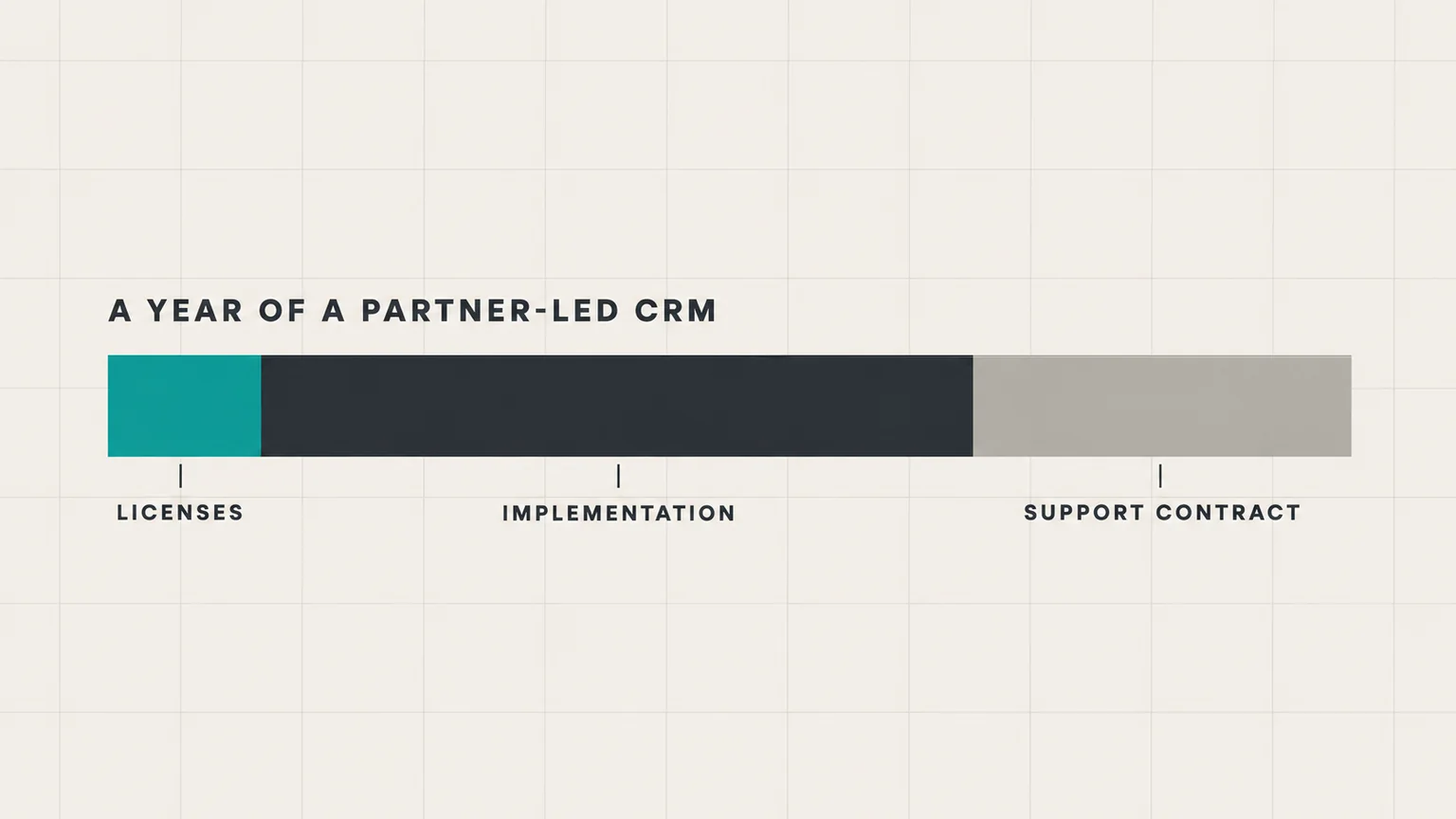
So build your 12-month number like this:
- license per user × users × 12, or the flat plan × 12
- plus implementation and training, if a partner is involved
- plus the support contract × 12
- plus your bank’s card fees on foreign-currency payments
- plus VAT, depending on how your accountant treats the purchase (check 4)
Then ask what happens at renewal. Introductory prices and first-year discounts are common, but the second year is the one you’ll actually live with.
4. Can you pay the way the vendor bills?
Check three things before you sign: the billing currency, whether your company card goes through, and whether you get a VAT invoice your accountant can use.
CRM software vendors based in Oman win this one. Amaal bills in Omani rials and issues Oman VAT invoices. Many international tools, however, bill in US dollars and issue no Omani VAT invoice. Because the rial has been pegged to the US dollar since 1986, at USD 2.6008 per rial (Central Bank of Oman), a dollar price is predictable. The foreign-currency fee your bank adds to card payments is not, so ask your bank before you compare totals. On VAT, Oman’s Tax Authority says a VAT-registered business buying software from a supplier outside Oman applies the reverse charge, which for a fully taxable business is “effectively a reporting requirement only”. Where the buyer isn’t VAT-registered, the foreign supplier is expected to register in Oman and charge VAT (Tax Authority e-commerce VAT guide, June 2023). Either way, ask your accountant how that applies to you.
Here is our own answer, since you would ask. LiftUp bills in US dollars through Razorpay, and our checkout doesn’t accept Omani cards today. You can still use the Free plan, or a 14-day Growth trial with no card, but a paid rollout needs a conversation with us about payment first.
5. Does support work on your week?
Your team works Sunday to Thursday. But many software vendors, and most offshore support desks, work Monday to Friday. That leaves Sunday, your first working day, without help, and Friday support you can’t use.
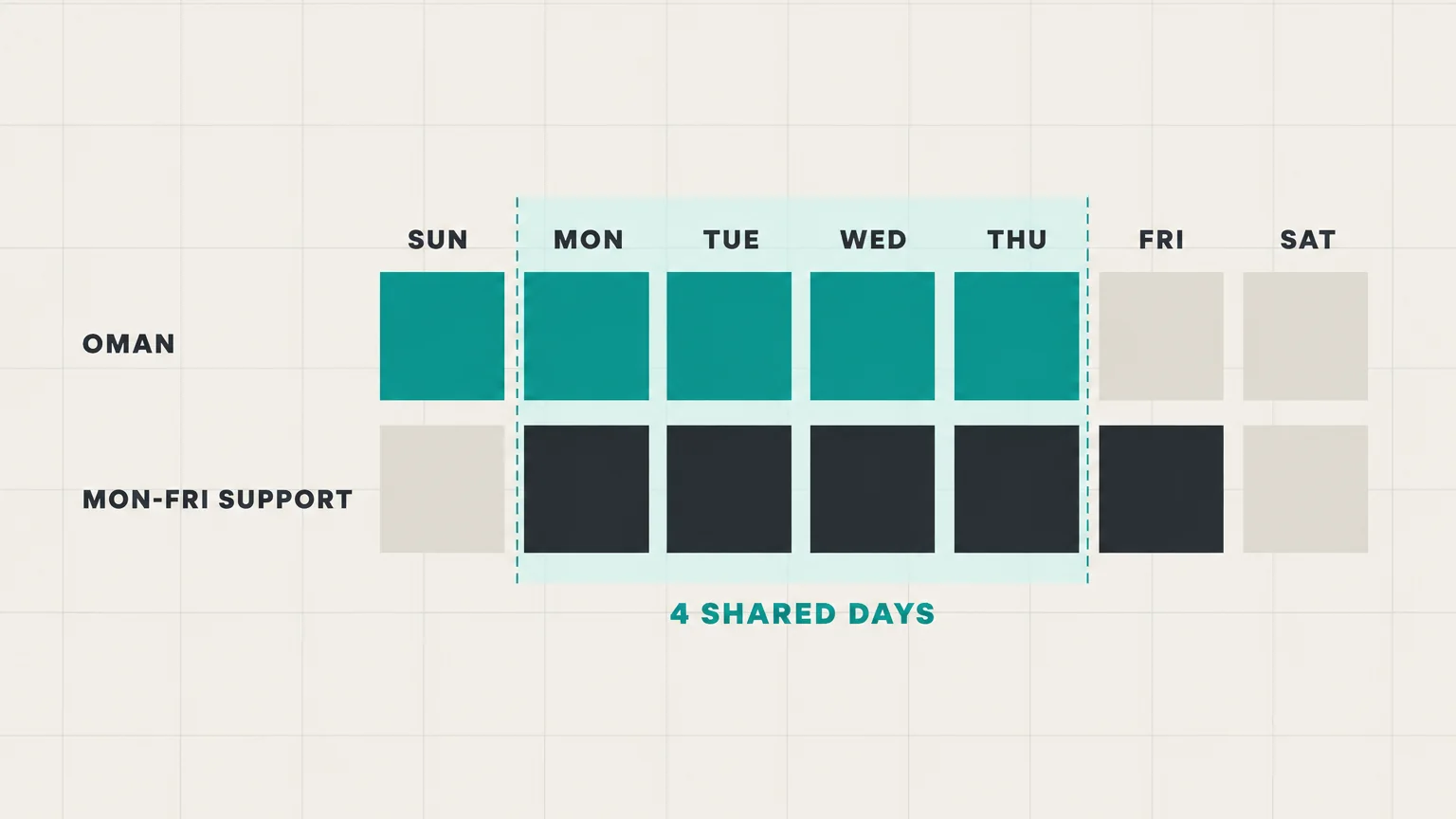
Ask every vendor for its support days and hours written in Gulf Standard Time (UTC+4), and ask who answers on a Sunday. Local partners usually match your week, which is part of what their fees buy. For the record: LiftUp’s support runs on Indian office hours, Monday to Friday. That covers Monday to Thursday of your week, but nothing on Sunday.
6. How will it handle consent on your lead forms?
Oman’s Personal Data Protection Law has been fully enforceable since 5 February 2026. Two parts matter for anyone collecting leads. Processing personal data needs the person’s explicit consent unless an exception applies (Article 10), and you need written consent before you send advertising or marketing messages (Article 22). Both are in the English translation of Royal Decree 6/2022.
For a CRM, that turns into four questions for the vendor:
- Where is the data hosted, and can you put that in writing?
- Can each lead record carry the consent your form collected, with a date?
- Can you find, export and delete one person’s data when they ask?
- Can marketing emails be limited to people who opted in?
This is general information, not legal advice. Have a lawyer who knows the Omani law check your forms and notices. A CRM can store what your form collects, but it can’t make your forms compliant.
7. Can it keep your brands apart?
Family groups often run a car dealership, a travel agency and a trading company under one owner and one small marketing team. Ask how the CRM separates brands: by tags, by pipelines, by separate accounts, or by a workspace per brand.
Zoho lets one account run up to five organizations on every edition. LiftUp gives each brand its own product with separate leads, forms, pipeline and API key: three brands on Starter and ten on Growth (how products keep brands separate in LiftUp). The limit to know: you can’t restrict a user to one brand. If brand teams must never see each other’s leads, use separate workspaces in any tool.
8. Does it follow your calendar?
Small things show up here: a workspace time zone of Asia/Muscat, booking pages that open on Sunday and close on Thursday, and reply deadlines that don’t quietly expire over your Friday and Saturday weekend.
Then test them in the trial. In LiftUp, you can set the workspace to Oman and Asia/Muscat, and booking pages take hours per weekday, including Sunday. The default is Monday to Friday, so switch it. Reply deadlines run on the clock, weekends included, so a hot lead that arrives on Thursday evening is due on Thursday night. That’s fine if someone covers it, and a problem if nobody does. (I wrote a separate guide on setting reply deadlines by lead score.)
9. Can you leave with your data?
Ask how you export leads, in which formats, and whether an annual maintenance contract or a multi-year license locks you in. A CRM you can’t leave is a CRM you’ll keep paying for after it stops fitting.
In LiftUp, leads export to CSV or Excel on every plan, including Free, and you can import up to 2,000 rows at a time from a CSV file.
Three ways to buy CRM software in Oman
Most shortlists for CRM software in Oman end up with one tool from each of three routes. Each route solves a different problem, so decide which problem is yours.
| Route | Examples | What you get | What to watch |
|---|---|---|---|
| Omani vendor | Amaal | OMR billing and VAT invoices, an Arabic-first interface, data kept in Oman, onboarding included | CRM is one module of a wider business system. Its site offers early access and mentions features still being finished, so ask what is live today. |
| Suite through a local partner | Zoho, Odoo | WhatsApp, Arabic options, deep features, a partner who works your week | Implementation fees, a monthly support contract, per-user pricing |
| Cloud tool bought directly | HubSpot, Bitrix24, LiftUp | Start the same day, no implementation project, prices on a public page | USD billing, support hours to check, card payments to test. Arabic varies: Bitrix24 has it, HubSpot and LiftUp don’t. |
When LiftUp fits as your CRM in Oman, and when it doesn’t
LiftUp is a reasonable pick if you are an English-first B2B team: training institutes, consultancies, agencies, logistics and trading firms, with enquiries coming through your website. It suits you best if you run more than one brand from one small team. From Starter up, every lead gets a 0 to 100 score and a reply deadline, and pricing is flat per organization: Starter at $49 a month for five users, Growth at $149 for twenty (see all plans). At the peg that’s about OMR 18.84 and OMR 57.29 a month, before any card fees.
It’s the wrong pick if:
- your customers mostly reach you on WhatsApp
- your team needs an Arabic interface
- you need VAT invoices, stock or accounting in the same system
- your procurement requires data hosted in Oman
- you need to pay by Omani card today
In those cases Amaal, Zoho through a local partner, or Odoo will serve you better, and I’d rather you pick one of them than fight your tools.
Your next step
Write the nine questions into one document and send it to three vendors before any demo. The written answers will narrow the list faster than a week of presentations. If you’re an English-first team with web enquiries across more than one brand, see how LiftUp CRM scores leads and sets reply deadlines, or book a demo and bring your questions, including the one about payment.
Frequently asked questions
How much does CRM software cost in Oman?
For licenses alone, prices checked on 27 September 2026 ran from OMR 1.25 per user a month (Amaal's SME rate, billed yearly) to about OMR 7.69 per user (HubSpot Starter at its $20 list price). Flat plans such as Bitrix24 Basic or LiftUp Starter cost about OMR 16 to 19 a month for up to five users. Partner-led projects add implementation fees and monthly support contracts, which can cost more than the licenses.
Which CRMs have an Arabic interface?
Amaal is Arabic-first, and Odoo and Bitrix24 offer Arabic interfaces. Zoho CRM lists Arabic (Egypt) as fully supported. HubSpot's list of interface languages has no Arabic, and LiftUp's interface is English only. Ask vendors separately about Arabic in forms, emails and saved records.
Which CRMs work with WhatsApp?
Zoho CRM and Bitrix24 offer WhatsApp integration, and Odoo offers WhatsApp as an app on its paid plans. If most of your enquiries arrive on WhatsApp, make native WhatsApp a must-have. LiftUp has no WhatsApp, SMS or calling.
Do I need a local implementation partner?
You usually do if you're rolling out a suite such as Zoho or Odoo with accounting, HR or custom workflows, or if your team needs Arabic training on site. A web-lead CRM for a small team can often be set up without one. Compare the partner's implementation fee and monthly support contract with the license cost before you decide.
Is my CRM data stored in Oman?
Only if the vendor says so in writing. Amaal states that its data is kept inside Oman. Zoho's nearest data centers are in the UAE and Saudi Arabia, not Oman. Ask every vendor where your data is hosted, and include the answer in the contract.
Does Oman's PDPL apply to the leads in my CRM?
Oman's Personal Data Protection Law (Royal Decree 6/2022) has been fully enforceable since 5 February 2026. It requires explicit consent to process personal data unless an exception applies (Article 10), and written consent before sending marketing messages (Article 22). This is general information, not legal advice; have a lawyer review your forms and notices.
Do I pay VAT on a CRM bought from a foreign company?
According to Oman's Tax Authority e-commerce VAT guide, a VAT-registered business applies the reverse charge, which for a fully taxable business is effectively a reporting step with no net tax. If the buyer isn't VAT-registered, the foreign supplier is expected to register in Oman and charge VAT. Confirm your own case with your accountant.
What is the difference between a CRM and an ERP?
A CRM tracks people who might buy from you: enquiries, follow-ups, meetings and deals. An ERP runs the business after the sale: invoices, stock, payroll and VAT. If issuing VAT invoices is your main need, start with an ERP suite; if unanswered enquiries are the problem, a CRM is the faster fix.

Abidhusain Chidi
Founder & CEO, QalbIT Infotech
Abidhusain Chidi is the founder and CEO of QalbIT Infotech, a software agency in Ahmedabad building web and SaaS products since 2018. He's also CTO at Seekly, an Australian revenue intelligence platform, and is building LiftUp. He writes about CRM, SaaS operations, and shipping multiple products as a small team.
See it live
Watch LiftUp run your whole growth stack
One console for CRM, content, AI editorial and insights — book a 30-minute walkthrough tailored to your team.
Book a demo