Lead Response SLA: How to Set One by Lead Score
Abidhusain Chidi13 min read
A demo request sent at 3 pm in New York reaches Ahmedabad at 12:30 am. If your team keeps Indian office hours, as mine has since 2018, nobody reads it for about nine hours. The buyer has the whole afternoon to email two other vendors. That gap is what a lead response SLA exists to close.
It isn’t a vague “we reply fast” but a written deadline for each lead, set by how promising the lead looks, with a named owner and a rule for what happens when the deadline is missed. This guide walks a team of three to ten people through setting one, and ends with a one-page policy you can copy.
What a lead response SLA actually is
A lead response SLA is an internal deadline for the first human reply to a new inbound lead. The term is borrowed from support contracts, but nobody outside your company signs this one. It’s a promise your team makes to itself, and it only works if it’s written down and checked every week.
You’ll also see “sales SLA” used for an agreement between marketing and sales departments about lead volume and follow-up speed. On a five-person team, marketing and sales are often the same two people, so it shrinks to one question: how long can a lead of this quality wait before someone answers?
How fast should you respond to leads? What the research measured
The figure everyone quotes comes from a 2011 Harvard Business Review article, “The Short Life of Online Sales Leads”. Read what it actually measured, because many posts that cite it blend two separate studies into one.
- The audit. The authors sent a test web lead to 2,241 US companies. 37% replied within an hour, 24% took more than a day, and 23% never replied at all. Among companies that did reply within 30 days, the average wait was 42 hours.
- The “seven times” figure. This came from a different dataset: 1.25 million leads at 42 US companies, 29 of them selling to consumers. Firms that tried to contact a lead within an hour were nearly seven times as likely to qualify it as firms that tried even an hour later, and more than 60 times as likely as firms that waited a day or longer.
Where the five-minute rule comes from
The five-minute rule is older still. It traces to a 2007 study run by the sales software company InsideSales.com with Professor James Oldroyd, covering three years of phone calls at six companies (archived study page). The researchers found the odds of reaching a lead by phone fell 100-fold between a five-minute and a thirty-minute call-back. It measured phone contact, not email replies, and the authors say plainly it didn’t look at closed deals.
Newer data isn’t kinder. In 2024, RevenueHero sent demo requests to 1,000 B2B SaaS companies and got 365 responses, averaging just over 29 hours, even with auto-replies counted.
My read: fast beats slow by a wide margin, and the exact multipliers matter less than people think. The five-minute target was built for phone teams sitting by a dialer. For a small team with no night shift, that promise gets broken by Tuesday. A four-hour lead response SLA you meet 95% of the time is worth more than a five-minute one you meet on good days.
Why one deadline for every lead fails
Pick one number for everything and you get one of two failures. Set it tight, say one hour, and the team burns its morning answering job seekers and student project enquiries who used the contact form, while the real buyer waits behind them. Set it loose, say 24 hours, and a pricing-page request from a 40-person company gets the same patience as a newsletter reply.
Score bands fix this. Each lead is sorted into hot, warm or standard when it arrives, and each band runs its own clock.
Step 1: Decide what makes a lead hot
You don’t need machine learning for this. You need five or six signals your forms already capture:
- Source. A referral or a search for your brand name beats a random directory listing.
- Page. Pricing, demo and “hire us” pages signal intent. A form at the bottom of a blog post usually doesn’t.
- Request type. A quote or a demo, not a job application or a partnership pitch.
- Detail. Two paragraphs about a real project outrank “pls send details”.
- Company. A company name, or a work email instead of a free-mail address.
- Spam risk. A low reCAPTCHA score or a throwaway address pulls the lead down.
Give each signal points, add them up to a score out of 100, and draw two lines. Above the top line is hot. Below the bottom line is standard. Everything between is warm.
No scoring tool yet? Use one question instead: did they ask for a price, a demo or a call? Yes means hot. A real question about their own project means warm. Everything else is standard. It’s crude, and it still beats treating every enquiry the same.
Step 2: Set lead response deadlines you can hit on your worst day
This is the step most teams skip. They copy a benchmark instead of looking at their own calendar.
Pull the last 30 days of leads and note the hour each one arrived, in your time zone. Then mark the hours when someone on the team can actually reply. The longest gap between “lead arrives” and “someone is at a desk” in a normal week is your honest floor for the hot band. If a hot lead can land at 11 pm and nobody starts until 9:30 am, a two-hour promise is fiction until you change who covers the evening.
A starting point that works for most small B2B teams:
| Band | Typical signals | First-reply deadline | Who answers |
|---|---|---|---|
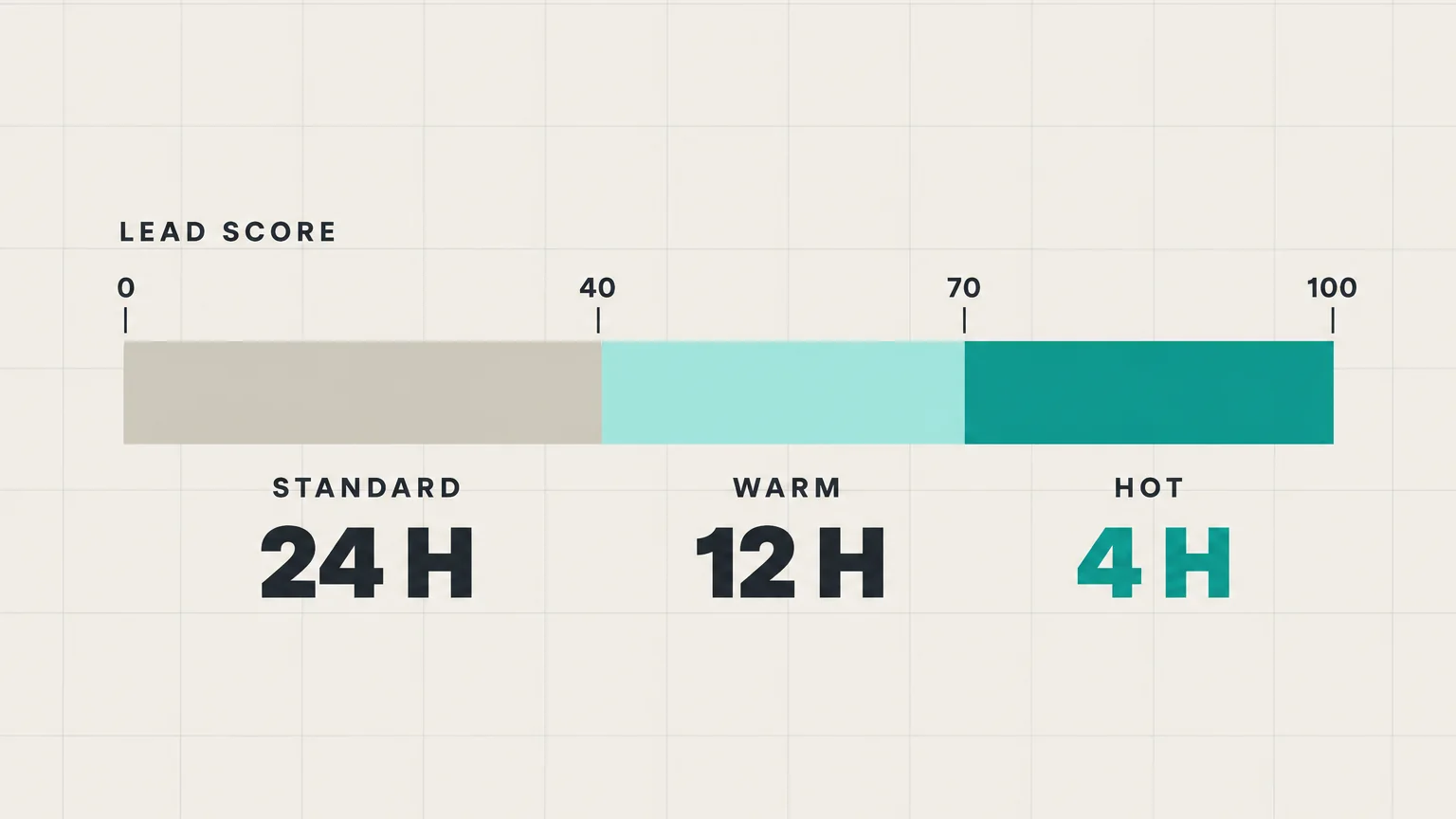
| Hot (score 70+) | Pricing or demo page, detailed brief, company email, referral | 4 hours | The named owner, or the founder if nobody owns it yet |
| Warm (40 to 69) | General contact page, some detail, company unclear | 12 hours | The named owner |
| Standard (under 40) | Blog forms, one-line messages, job and partnership enquiries | 24 hours | Whoever triages the inbox that day |
A worked example: the bands LiftUp uses
Those numbers aren’t pulled from the air. They’re the defaults we built into lead scoring and reply deadlines in LiftUp CRM, which come with every paid plan from Starter up. Each lead gets a 0 to 100 score from visible rules: source, landing page, enquiry type, reCAPTCHA confidence, how much the person wrote, and whether a company is attached. A score of 70 or more gets a 4-hour deadline, 40 to 69 gets 12 hours, and anything lower gets 24. The deadline is stamped when the lead is created. You can re-weight each factor, so a team whose best leads come from LinkedIn can push that signal higher.
If your forms post leads through code rather than an embedded form, the LiftUp lead API returns the score and the reply deadline in its response, so your own scripts can act on it straight away.
Define what counts as a first response
Write this rule down, or your numbers will flatter you.
My rule: a first response is a message from a person that answers the question or proposes a concrete next step. By that test:
- An auto-reply saying “thanks, we’ll be in touch” doesn’t count. Send one anyway, because it reassures people. The clock keeps running, though.
- A templated reply that names their project and offers two call slots counts.
- A bare booking link with no line about what they asked is borderline. I count it only when the enquiry was literally “can we talk?”
- A call that went to voicemail doesn’t count until a written follow-up goes out.
One honest note about tooling, including ours. In LiftUp, the deadline stops when someone moves the lead out of “New”. The software can’t tell whether a real reply went out before that click. So the policy has to say it plainly: change the status after you reply, never before. Any CRM that stops the clock on a status change has the same weak spot.
Business hours or wall clock? The time-zone problem
Most lead response SLA advice quietly assumes the buyer and the rep share a working day. Sell from India to the US, or from London to California, and they don’t.
Here is the overlap for a team in India selling to the US east coast. India stays on UTC+5:30 all year, while US Eastern time moves back an hour when daylight saving ends on Sunday, 1 November 2026.
| Lead arrives (New York) | Time in India, until 1 Nov 2026 | Time in India, from 1 Nov 2026 |
|---|---|---|
| 9:00 am | 6:30 pm | 7:30 pm |
| 1:00 pm | 10:30 pm | 11:30 pm |
| 3:00 pm | 12:30 am | 1:30 am |
| 6:00 pm | 3:30 am | 4:30 am |
Two ways to run the clock
That leaves two honest choices.
- A business-hours clock. The deadline counts only the hours your team works. It’s fair to the team, but do the maths before you pick it. A hot lead sent at 3 pm on a Tuesday in New York, during US summer time, reaches India at 12:30 am. The four business hours start at 9:30 am, so the reply is due at 1:30 pm India time. That’s 4 am in New York. Your reply is technically on time, and the buyer reads it over breakfast, 18 hours after asking.
- A wall clock with a coverage window. The deadline runs day and night, and you staff the overlap. One person working 6:30 to 10:30 pm in India covers the first four hours of the New York morning, or 7:30 to 11:30 pm once the US clocks change.
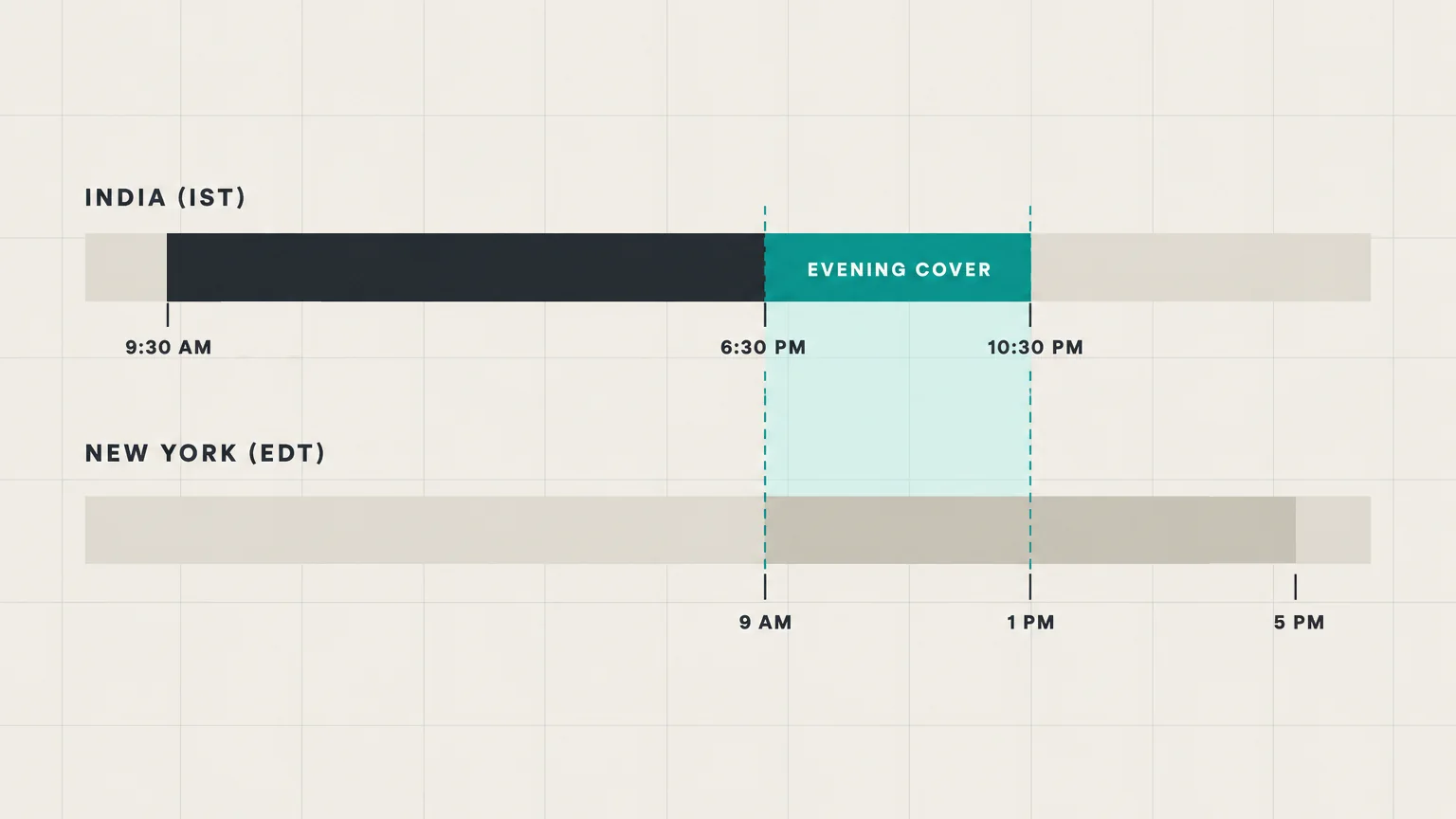
My take: run the hot band on the wall clock and let the other bands follow business hours. A hot lead from your best market deserves an evening shift. A job enquiry can wait for Monday.
Holidays and weekends
Put holidays in the policy too, because yours and your buyers’ don’t line up. A Diwali week off in India is an ordinary working week in New York, and US Thanksgiving (26 November this year) is an ordinary Thursday in Ahmedabad. Name the person covering hot leads on those days before they arrive.
If you use LiftUp, its deadlines run on the wall clock. A hot lead that arrives at 8 pm on a Friday is due at midnight, with no pause for evenings or weekends. So the coverage plan has to exist in real life, not just in the policy.
Who owns the lead, and who owns the SLA breach
Deadlines don’t reply to leads. People do. In small teams the usual failure isn’t a slow reply. It’s a lead nobody was assigned to, sitting in a shared inbox where everyone assumes someone else has it.
The other quiet leak is the enquiry that never reaches your CRM at all: an email to hello@, a LinkedIn message to the founder, a voicemail. None of those start a clock unless someone logs them.
Five rules close both gaps:
- Every new lead gets a named owner within one hour during working hours.
- Whoever spots an enquiry outside the CRM logs it as a lead the same day, with the time it actually arrived.
- A lead still unassigned at its deadline belongs to the founder or sales lead by default.
- Each breach reaches that person the same day, with one question attached: what stopped the reply? Not who.
- Before anyone goes on leave, they hand their open leads to a named colleague and change the owner field. Not after they’re back.
Tools help only if they make a breach hard to miss. In LiftUp, a check every 30 minutes flags leads past their deadline with no first response, and they land in a Needs-attention queue alongside leads unassigned for over 24 hours, contacted leads quiet for a week, and overdue tasks. The queue comes with the Starter plan and above. Auto-assign, switched on per product, hands each new lead to the teammate with the fewest open leads.
A one-page lead response SLA template
Copy this, fill in the brackets, and pin it wherever your team actually looks. One page is the point. If it runs to three, nobody reads it on a busy Friday.
LEAD RESPONSE SLA: [Company name]
Policy owner: [name]                  Last reviewed: [date]

1. SCOPE
Every new inbound lead from our website forms, booking pages and lead API.
Enquiries by email, LinkedIn or phone: logged as leads the same day,
with the time they actually arrived.
Not existing customers (they follow the support policy).

2. BANDS AND DEADLINES (first human reply)
Hot       score 70+      within 4 hours   wall clock, 7 days a week
Warm      score 40-69    within 12 hours  [wall clock / business hours]
Standard  score under 40 within 24 hours  [wall clock / business hours]

3. WHAT COUNTS AS A FIRST RESPONSE
A message from a person that answers the question or proposes a next step.
Auto-replies do not count. Change the lead status after replying, never before.

4. COVERAGE
Working hours:          [e.g. Mon-Fri, 9:30 am-6:30 pm IST]
Evening cover (hot):    [name], [e.g. 6:30-10:30 pm IST], Mon-Fri
Weekend cover (hot):    [name or rota]

5. OWNERSHIP
Every lead has a named owner within [1 hour] during working hours.
Unassigned at the deadline: [founder / sales lead] owns it.
Going on leave: hand open leads to [name] and update the owner field first.

6. BREACHES
A breached lead gets a reply within [1 hour] of being noticed.
Log one cause per breach: unassigned / off-hours / owner away / missed.

7. WEEKLY REVIEW ([day], 15 minutes)
- Hot leads answered within the deadline: [target, e.g. 95%]
- Slowest first reply in each band
- Breaches grouped by cause
- Leads with no reply at all (target: 0)
- One change for next week: [write it here]
The 15-minute weekly review
Writing the lead response SLA is the easy part. The review is where it becomes a habit or quietly dies by week three.
Four numbers are enough:
- Hot leads answered within the deadline, as a percentage. Aim for 95%. Consistently lower means the deadline or the coverage is wrong, not the people.
- The slowest first reply in each band. Averages hide the one lead that waited three days, and that’s usually the one you lost.
- Breaches grouped by cause. Mostly “unassigned” means fix routing. Mostly “off-hours” means fix coverage. Fix both of those before you look at individuals.
- Leads that never got a reply. The target is zero. Anything above zero gets a name next to it.
Then change one thing. Just one. Next week, check whether it moved the number. Once a quarter, check the bands themselves: if half your “standard” leads turn into deals, the scoring is wrong, not the team.
When a formal lead response SLA is overkill
This isn’t for everyone. If you get fewer than five leads a week and the founder answers every one the same day, skip the bands and the template. Write one line, “every enquiry gets a personal reply the same working day”, and spend the saved time getting more leads.
And if your buyers expect a phone call within minutes, as in insurance, home services or high-volume consumer sales, you need a dialer and SMS. LiftUp has no calling, SMS or WhatsApp. It scores web and API leads and gives each one a reply deadline, and that’s the job it’s built for.
Your next step
Open last month’s leads, note the hour each one arrived, and check how long the hot ones waited for a human reply. If the answer makes you wince, the lead response SLA template above is a Monday-morning fix. If you’d rather see score bands, reply deadlines and the Needs-attention queue working on leads like yours, book a short LiftUp demo.
Frequently asked questions
What is a good lead response time for B2B sales?
For a small team, a first human reply within 4 hours for hot leads, 12 hours for warm leads and 24 hours for the rest is a realistic starting point. Faster is better: in the 2011 Harvard Business Review research, firms that tried to contact a lead within an hour were nearly seven times as likely to qualify it as firms that tried an hour later. Set a deadline you can actually meet, then tighten it.
What does SLA mean in sales?
SLA stands for service level agreement. In larger companies, a sales SLA is an agreement between marketing and sales about lead volume and follow-up speed. On a small team it usually means one thing: a written deadline for the first reply to each new lead.
Does an automated email count as a lead response?
No. An auto-reply confirms the enquiry arrived, which is useful, but it doesn't answer anything. Count a response only when a person answers the question or proposes a concrete next step. Otherwise your response-time numbers will look far better than your buyers' experience.
Should lead response time exclude weekends?
Decide per band. A business-hours clock is fairer to your team but can leave a hot lead waiting a whole weekend. A common compromise is to run the hot band on the wall clock with a named weekend cover, and let warm and standard leads wait for the next working day.
How do you calculate lead response time?
Measure the time from when the lead arrived to the first human reply, per lead. Report the share of leads answered within their deadline and the slowest reply in each band, not just the average. For enquiries that arrive outside your CRM, log the real arrival time, not the time someone entered them.
What is the 5-minute rule for leads?
It's the idea that you should contact a web lead within five minutes. It traces to a 2007 study by InsideSales.com and Professor James Oldroyd of phone call-backs at six companies. It measured phone contact, not email replies or closed deals, so treat it as a direction rather than a target for a small team.
How should you handle leads that arrive after hours?
Send an auto-reply that says when a person will answer, then make sure someone does. For hot leads, name an evening or weekend cover, especially if your buyers are in another time zone. Standard leads can usually wait for the next working day.
Are the speed-to-lead statistics reliable?
The direction is well supported, but the famous numbers are often misquoted. HBR's 2,241-company audit measured how fast firms replied; the seven-times figure came from a separate study of 42 companies, 29 of them consumer businesses. The five-minute figure came from phone data at six companies. Use them as evidence that speed matters, not as exact benchmarks.

Abidhusain Chidi
Founder & CEO, QalbIT Infotech
Abidhusain Chidi is the founder and CEO of QalbIT Infotech, a software agency in Ahmedabad building web and SaaS products since 2018. He's also CTO at Seekly, an Australian revenue intelligence platform, and is building LiftUp. He writes about CRM, SaaS operations, and shipping multiple products as a small team.
See it live
Watch LiftUp run your whole growth stack
One console for CRM, content, AI editorial and insights — book a 30-minute walkthrough tailored to your team.
Book a demo