CRM for Training Institutes in Oman: A Setup Guide
Abidhusain Chidi10 min read
EduTraC Oman 2026 runs from 12 to 14 October at the Oman Convention & Exhibition Centre, and its organiser lists more than 9,266 visitors, students and parents among them. For three days your stand collects names faster than anyone can call them back. The hard part starts on 15 October, when a stack of names has to become campus visits and applications before another institute calls them first. That’s the job a CRM for training institutes should do.
This guide sets up a CRM for training institutes in Oman to handle exactly that: an enquiry-to-enrolment pipeline, a way to decide which enquiries to answer first by programme and intake, reply deadlines that fit a Sunday-to-Thursday week, and consent rules for enquiries about students under 18. It works for a private college, a training centre or a language institute, with one campus or several.
We build LiftUp, a CRM for inbound leads, so I’ll show how each step works there and say plainly where it doesn’t fit. Every step also works in any other CRM.
What a CRM for training institutes in Oman has to handle
The sector is bigger and more regulated than its marketing suggests. According to the National Centre for Statistics and Information, private institutions made up 68% of Oman’s higher education institutions in the 2024/25 academic year. On the training side, the Ministry of Labour’s Director General of Private Training Institutions said in October 2026 that 62 licensed private training institutions operate across the governorates, as reported by Muscat Daily. Vocational training moved to the Ministry of Labour under Royal Decree 61/2024. Higher education now sits with the Ministry of Education, after the January 2026 decree that merged it with the former Ministry of Higher Education, Research and Innovation.
Three things about Oman shape how your CRM should be set up.
- Enquiries arrive in waves. The Higher Education Admission Center announced its first-round results on 19 August, with 33,031 offers, including 14,950 domestic scholarships and grants at private institutions. Results days, open days and fairs like EduTraC tend to bring spikes, with quieter weeks in between.
- Intakes differ by institution. Muscat College runs three foundation intakes a year, in September, December and March, while Muscat University has one, in September. So an enquiry is only urgent relative to the intake it’s for.
- The working week runs Sunday to Thursday. Oman has used a Friday and Saturday weekend for both public and private sectors since 2013. Any reply deadline has to account for enquiries that arrive on Friday.
The enquiry-to-enrolment pipeline for training institutes
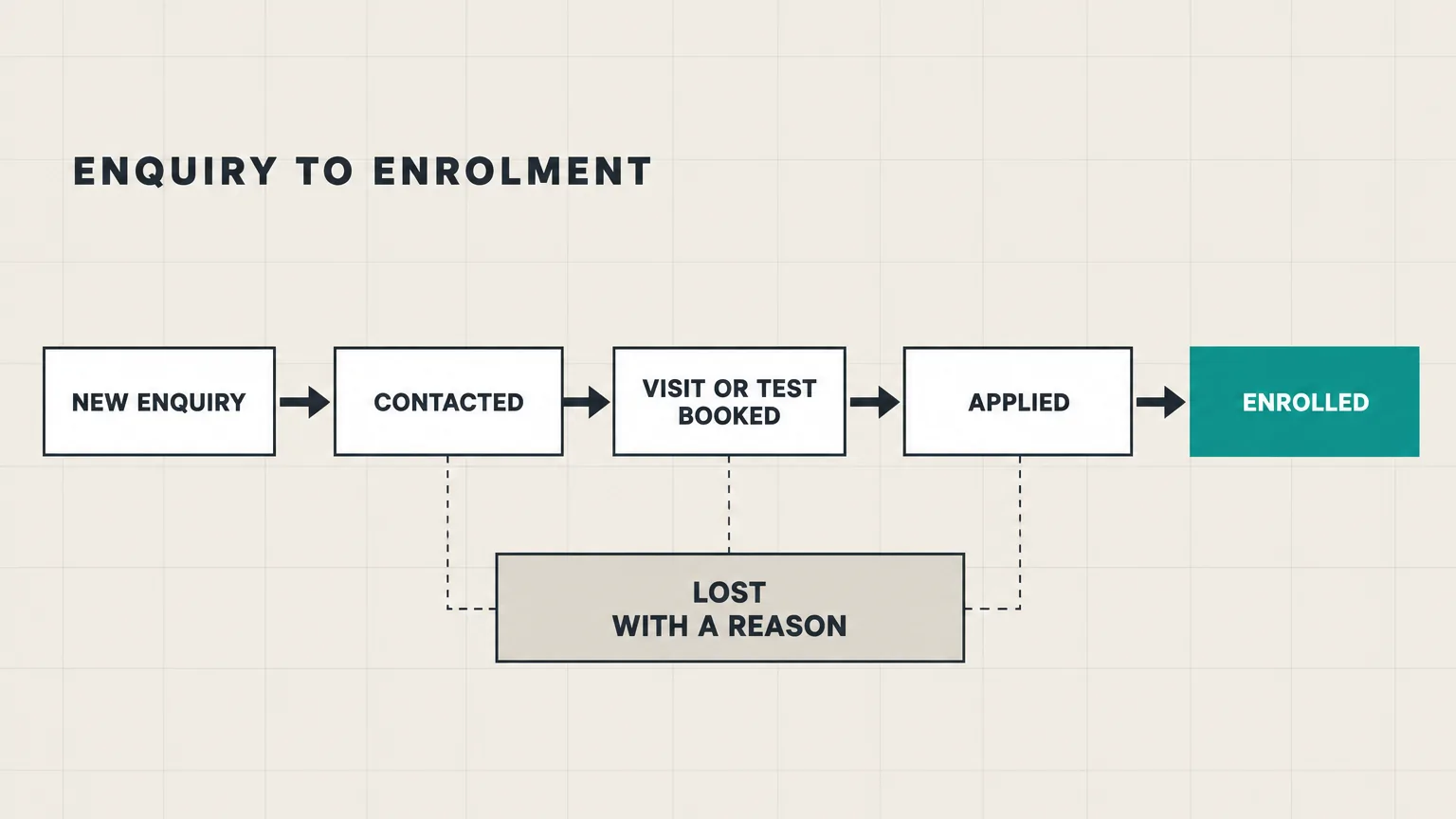
Keep the pipeline short. Each stage needs a clear rule for moving forward, or counsellors will park leads wherever feels right:
- New enquiry: the form or stand entry has arrived, and nobody has replied yet.
- Contacted: a counsellor has replied with something specific, such as fees, entry requirements or the next intake date.
- Visit or test booked: a campus visit, counselling session or placement test has a date and time.
- Applied: the application is in, and the institute is waiting on documents or test results.
- Enrolled: the student has accepted and paid, so you close the lead as won.
- Lost: close it with a reason, such as fees, timing, a competitor or no response, because those reasons tell you what to change for the next intake.
Stages 3 and 4 are where a CRM pays for itself. A parent who booked a visit and didn’t come is the most valuable name on your list, and without a stage for it, nobody notices.
In LiftUp, you can name stages like these and map each one to a built-in status: new, contacted, qualified, won or lost. Stages apply to the whole workspace, so every campus shares the same pipeline, which keeps reports comparable.
Capture every enquiry with the same fields
Any CRM for training institutes depends on clean data, so an enquiry from the website and one taken at a stand should land in the same place, with the same fields. Five fields do most of the work:
- Programme: a dropdown, not free text, so you can count and route by it.
- Intake: the term they want to start, such as “January 2027”.
- Who is asking: student, parent or guardian, or employer.
- Student under 18: a yes or no, because it changes your consent rules (more on that below).
- Source: website, EduTraC, referral, school visit, social media or walk-in.
For EduTraC, put the form on a tablet at the stand rather than collecting paper forms. Pre-set the source to “EduTraC 2026” so you can measure the show later, and keep the form under a minute to fill in. The fair runs from 9 am to 1 pm and again from 4 pm to 8 pm, so staff the stand and the form for both sessions.
In LiftUp, each of these can be a custom field on your lead form, from Starter up. A programme dropdown can also double as the form’s topic, which makes it searchable in the inbox and usable in assignment rules.
Decide which enquiries training institutes answer first
After a fair like EduTraC, you won’t reach everyone on the first day, so decide the order before it opens. A simple points rubric works better than gut feeling:
| Signal | Points |
|---|---|
| Intake starts within 8 weeks | 30 |
| Programme still has seats for that intake | 20 |
| Already holds a scholarship or sponsor offer | 20 |
| Asked about fees, documents or a visit date | 20 |
| Parent or guardian enquiring for a school leaver | 10 |
Above 60 is hot, 30 to 60 is warm, and anything lower is standard. The numbers are a starting point; adjust them after one intake, when you can see which enquiries actually enrolled.
Be clear about what LiftUp does here. Its lead score runs on six fixed signals: source, the page the form was on, enquiry type, the reCAPTCHA spam check, how much the person wrote, and whether they named a company. You can change how much each signal counts, but programme and intake don’t feed the score. What you can do is route by programme: an assignment rule can send every enquiry about one programme to the counsellor who knows it, and the intake field stays on every lead for the counsellor to see.
Reply deadlines for training institutes
A reply deadline turns “we’ll call them back” into a time. Set one per priority band:
- Hot: within 4 hours.
- Warm: within 12 hours.
- Standard: within 24 hours.
Then decide what happens to enquiries that arrive on a Friday, which in Oman is the start of the weekend. Either one counsellor covers a short window on Saturday, or your auto-reply tells parents exactly when they’ll hear from you, and the Sunday rota answers hot leads first. During EduTraC, assign a counsellor to enter each session’s enquiries the same evening, so the clock starts on time.
LiftUp sets these same 4, 12 and 24-hour deadlines from the lead score, and they run on the wall clock, weekends included. That’s stricter than many institutes need, so plan the Saturday cover rather than relying on the clock to pause. Our guide to setting a lead response SLA by lead score covers how to pick the hours and who covers them.
Consent rules when the student is under 18
Many of your enquiries are about school leavers, and Oman’s Personal Data Protection Law treats their data differently. Article 6 prohibits processing a child’s personal data except with the approval of the child’s guardian, unless it’s in the child’s best interest. Oman’s Child Law defines a child as anyone under 18, which covers most students finishing their General Education Diploma. Applying that definition to data protection is our reading, so confirm it with your lawyer.
The law sets two other rules that touch every enquiry form:
- Consent must be explicit, and you must be able to prove it. Article 10 says the controller shall prove the data subject’s written consent.
- Marketing needs written consent first. Article 22 requires written consent before you send advertising or marketing material, and the Executive Regulation adds a way to opt out.
Fines are significant. Breaching Article 6 carries a fine of RO 15,000 to RO 20,000.
In practice, add two things to every form. First, add a “student under 18” question, and when the answer is yes, ask for the parent or guardian’s name and contact details. Second, add a consent checkbox that names the purpose, such as “contact me about this programme”. Keep marketing consent as a separate, unticked box.
In LiftUp, consent is a checkbox custom field, stored with the lead along with the date it arrived. There’s no separate consent log, so if your lawyer wants one, keep it alongside the CRM. This is general information, not legal advice.
One product per campus
If you run more than one campus or brand, give each its own space in the CRM. Otherwise the Sohar enquiries end up in the Muscat counsellor’s list, and nobody can tell which campus the fair actually helped.
LiftUp handles this with products. Each campus becomes a product with its own lead forms, inbox, custom fields and API key, and you switch between them from the top bar. Starter covers three products and Growth covers ten, and our multi-product setup page shows how they sit side by side. One limit to know: everyone on the team can switch to every campus. You can limit sales staff to the leads assigned to them, but not to one campus. If your campuses sit inside a wider family group, our guide to a CRM for a group of companies covers what stays shared across them.
A follow-up plan for the week after EduTraC
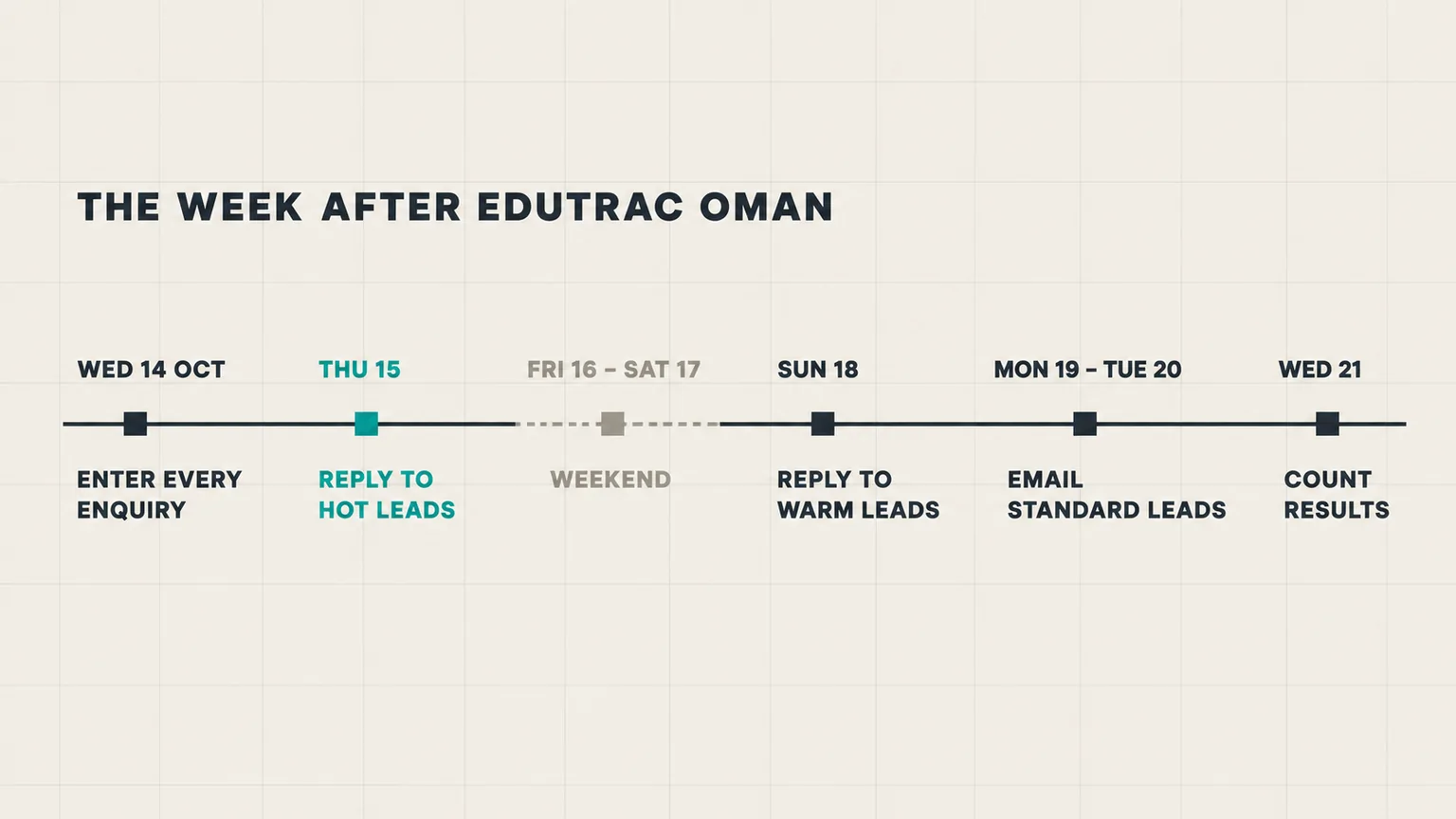
EduTraC Oman 2026 ends on Wednesday, 14 October. Here’s a plan for the next five working days, and the same shape works after any fair or open day:
- Wednesday evening: make sure every enquiry from all three days is in the CRM with its programme, intake and source.
- Thursday, 15 October: reply to every hot enquiry with something specific, such as the next intake date and a visit slot.
- Sunday, 18 October: reply to the warm enquiries, then call the hot ones that haven’t answered.
- Monday and Tuesday: send standard enquiries a short email with the programme guide, and confirm the week’s visits.
- Wednesday, 21 October: count enquiries by source, visits booked and applications started. That’s your EduTraC result, and next year’s budget case.
If you’re still choosing a CRM, our checklist for CRM software in Oman covers Arabic, billing in rials and data protection.
Where LiftUp fits, and where it doesn’t
As a CRM for training institutes, LiftUp fits English-first institutes whose enquiries come from their website, forms and booking pages, and who want those enquiries scored, assigned and timed in one place. Booking pages can open on Sunday and follow Muscat time once the workspace is set to Oman. Lead scoring, reply deadlines and custom fields are all available from Starter up, as our CRM features page shows.
Who LiftUp isn’t for: institutes whose parents mostly enquire by WhatsApp or phone, because LiftUp has no WhatsApp inbox, calling or SMS. It also has no Arabic interface, and it isn’t a student information system, so it won’t manage timetables, fees or attendance once the student enrols.
Next step
Before your next fair, open day or intake, decide three things: the five form fields, the points rubric and who covers Friday and Saturday. Then put the follow-up plan in your counsellors’ calendars. If you’d like to see a CRM for training institutes running this pipeline, book a 30-minute LiftUp demo and bring your programme list.
Frequently asked questions
What should a CRM for a training institute track?
Track each enquiry from first contact to enrolment, with the programme, the intake the person wants, who is asking (student, parent or employer), whether the student is under 18 and where the enquiry came from. A short pipeline of new, contacted, visit or test booked, applied, enrolled and lost covers most institutes.
When is EduTraC Oman 2026?
EduTraC Oman 2026 runs from 12 to 14 October at the Oman Convention & Exhibition Centre in Muscat, from 9 am to 1 pm and 4 pm to 8 pm each day, according to the organiser's website. It is the 13th edition of the higher education, training and career expo.
How fast should an institute reply to a student enquiry?
Set deadlines by priority: within 4 hours for hot enquiries, 12 hours for warm ones and 24 hours for the rest. In Oman, plan who covers Friday and Saturday, because enquiries keep arriving over the weekend.
Do I need a parent's consent to contact a student under 18 in Oman?
Oman's Personal Data Protection Law prohibits processing a child's personal data without the guardian's approval, unless it is in the child's best interest, and the Child Law defines a child as anyone under 18. Ask whether the student is under 18 on your form and collect the guardian's consent and details. Confirm your process with a lawyer.
Who regulates private training institutes in Oman?
The Ministry of Labour licenses and supervises private training institutions, after Royal Decree 61/2024 moved vocational training to it. Higher education sits with the Ministry of Education, which absorbed the former Ministry of Higher Education, Research and Innovation in January 2026.
Can one CRM handle several campuses?
Yes, if it can keep each campus's enquiries apart. In LiftUp, each campus can be its own product with separate forms, inbox and custom fields: three on Starter and ten on Growth. Everyone on the team can still switch between campuses, so LiftUp can't restrict a counsellor to one.
Can LiftUp score enquiries by programme or intake?
Not directly. LiftUp scores leads on six fixed signals, such as source, the form's page and how much the person wrote, and you can change how much each one counts. Programme and intake don't change the score, but an assignment rule can route each programme's enquiries to the right counsellor.

Abidhusain Chidi
Founder & CEO, QalbIT Infotech
Abidhusain Chidi is the founder and CEO of QalbIT Infotech, a software agency in Ahmedabad building web and SaaS products since 2018. He's also CTO at Seekly, an Australian revenue intelligence platform, and is building LiftUp. He writes about CRM, SaaS operations, and shipping multiple products as a small team.
See it live
Watch LiftUp run your whole growth stack
One console for CRM, content, AI editorial and insights — book a 30-minute walkthrough tailored to your team.
Book a demo