Content Marketing Oman: A 90-Day B2B Plan
Abidhusain Chidi12 min read
Late in 2025, LinkedIn counted 1.30 million registered members in Oman. For content marketing in Oman, that is an audience you can reach without a media budget. But an article only pays off if someone answers the enquiry it produces, and a contact form that drops into a shared inbox nobody owns can sit from Thursday evening until Sunday afternoon. Traffic is rarely the weak link. The gap between a reader and a reply usually is.
What follows is a 90-day plan a small team can run, written for the founder or marketing lead of a B2B company in Oman, or a Muscat agency doing the work for one. It works backwards from the lead form. Measurement and the reply routine come first, publishing runs Sunday to Thursday, and the last stretch reviews what earned attention and cuts the rest. We build LiftUp, a CRM, so I’ll flag the few places where what happens after the article matters. Figures below were checked on 11 October 2026.
What is different about content marketing in Oman
Most local advice stays abstract: respect the culture, be bilingual, build trust. The numbers and the calendar are more useful, so start there.
- Reach is high. DataReportal’s Digital 2026 report for Oman counts 5.28 million internet users at the end of 2025, or 95.3% of the population. It also counts 3.44 million social media identities, equal to 62.1%. One person can hold several, so read that as accounts, not a head count.
- LinkedIn is sizeable, with a caveat. The same report gives LinkedIn 1.30 million members, equal to 23.5% of the population. These are registered members taken from LinkedIn’s ad tools, not monthly active users, so treat the figure as a ceiling on reach.
- Google dominates search. StatCounter showed Google with 93.13% of searches in Oman in September 2026, with Bing at 6%.
- The week is Sunday to Thursday. Oman moved to a Friday and Saturday weekend for public and private sectors, so Sunday is a normal working day for your buyers.
One more caution. Many agency pages say Omani buyers prefer relationships to content and that bilingual outreach is essential. Those are sales pitches, not measured studies. They may be true for your accounts, but test them with your own customers before you build a plan on them.
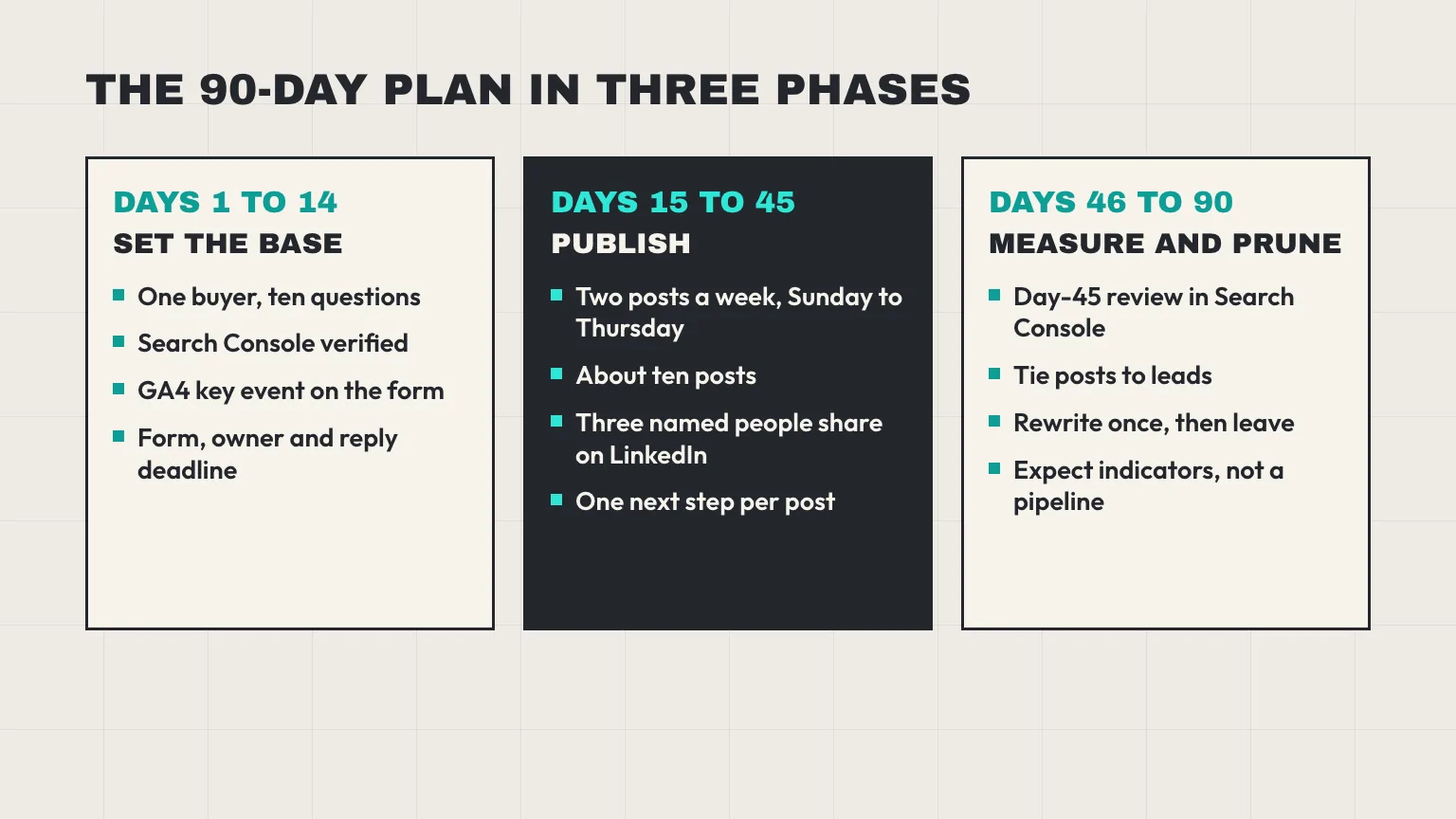
Days 1 to 14: set the base before you write
If you start content marketing in Oman by publishing, you find out at day 60 that you cannot tell what worked. The first two weeks are boring on purpose.
Pick one buyer and ten questions
Choose a single buyer: the operations manager at a 20-person logistics firm, say, or the owner of a training centre. Then book 30 minutes with whoever takes your sales calls and write down the ten questions buyers ask most. Use their words, not yours.
Those ten questions are your first ten articles. For content marketing in Oman, a question that comes up in every call beats anything a keyword tool suggests, because the tools show little search data for a market this small.
Set up Search Console and one key event
Verify your site in Search Console. Its Performance report shows clicks, impressions, click-through rate (clicks divided by impressions) and average position. You will read it on day 45.
In GA4, mark the form submit as a key event. Google describes a key event as an action that is particularly important to the success of your business, and any event you collect can be marked as one. Write down today’s numbers, even if they are tiny. A baseline of near zero is still a baseline.
Build the lead form and the reply routine first
Keep the form to four fields: name, work email, company and a free-text “What do you need?” box. Then decide who answers it and by when. Agree a reply deadline in writing, such as “same working day, Sunday to Thursday”, and name a backup for when the owner is travelling.
Also add two hidden fields to the form: the page the visitor was on, and a source label. Without them you can’t say which article produced a lead on day 90. Our guide to setting a lead response SLA by lead score shows how to set deadlines that match how serious each enquiry looks.
Days 15 to 45: publish twice a week
Two posts a week from day 15 to day 45 gives you about ten articles, which matches the ten buyer questions. I picked that rhythm because it is easy to sustain with one writer and one editor. It is not a benchmark, and I have no data that says two beats three. If you can only manage one post a week, publish one and keep going.
Publish on working days. A Friday post lands on your buyers’ weekend and gets read, if at all, on Sunday, so pick two fixed weekdays and keep them.
Write plain English for second-language readers
Many of your readers will use English as a second or third language. That is not a reason to write down to them. It is a reason to write clearly:
- Keep most sentences under 20 words.
- Define a term the first time you use it, then use the same word every time.
- Avoid idioms such as “move the needle” or “low-hanging fruit”. They translate badly.
- Put numbers, prices and dates in digits, with the unit and the currency.
This is editorial advice from our own writing, not a finding from a study. Clear text is also easier to translate later, which helps if you add Arabic.
The first ten content marketing posts
A workable mix for a B2B company with a single service line:
- Four how-to answers to the most common buyer questions.
- Three cost or comparison posts, with prices checked and dated, because buyers search for these late in their decision.
- Two client stories, only with the client’s written permission and real numbers.
- One local explainer, such as how a rule or process in Oman works for your type of customer.
Each post ends with one next step, usually the form. Pick one, not three. A reader offered a webinar, a newsletter and a demo often takes none of them.
Keep one voice when several people write
Once the sales lead, the founder and an agency all write for you, the posts start to sound like different companies. Fix this with a short style sheet and one editor. Our editor’s checklist for brand voice covers the checks. If your drafting tools use AI, Google’s guidance on creating helpful content says to ask who created the page, how, and why, and to say how automation was used where readers would expect to know.
LiftUp’s content features can build a writing style from a product’s published posts on Starter and above. That helps keep a team’s drafts consistent, though it doesn’t replace an editor.
LinkedIn for content marketing in Oman: three named people
With 1.30 million registered members in the country, LinkedIn is the obvious place to share a B2B article. The question is who shares it.
My view is that a company page alone gets little pickup. Pick three named people, such as the founder, the sales lead and one senior specialist, and let each share the post with one sentence on why it matters to their own contacts. I have no data on the best time or day to post in Oman, and I would distrust anyone who quotes one. Choose a slot inside the working week and keep it steady for 90 days.
Share each article once with context, not three times with the same link. Then keep a note of which person’s share brought replies. Some of the people who respond will never open the post. They will message you, and those chats are leads too, so log them in the CRM by hand with the source “linkedin”.
Arabic pages for content marketing in Oman
“Should it be Arabic or English?” is the question I’d expect most from Omani teams. The honest answer for content marketing in Oman is that it depends on the buyer, and the sales team knows. If your last 20 enquiries came in English, start in English. If government or family-owned buyers keep asking for Arabic material, add Arabic versions of the pages they read.
Google’s documentation on localized versions of a page gives the mechanics:
- Use a separate URL for each language version. Google says a translated page is not a duplicate; versions count as duplicates only if the main content stays untranslated.
- Use hreflang annotations so Google knows the variants exist. Each version should list itself and all the others.
- Don’t rely on the HTML lang attribute or hreflang for language detection. Google says it does not use either to work out the language of a page.
- Write the title in the same language as the page. Google’s guidance on title links says the title text should match the language and writing system of the main content.
Have a person who writes Arabic professionally review any translation before it goes live. A page that reads like a machine translation does your brand little good, and the Google guidance on helpful content applies to Arabic pages as much as to English ones.
Days 46 to 90: measure content marketing results and prune
Most plans run out of steam here, which is a pity, because this stretch tells you what to write next.
The day-45 review
Open Search Console and export queries and pages for the last 28 days. Sort pages by impressions. You are looking for three groups:
- Posts with impressions but few clicks. The title or description needs work.
- Posts with clicks but no form submits. The next step at the end is weak, or the topic attracts the wrong reader.
- Posts with neither. Rewrite once, then leave them.
Write the next ten posts from the first group’s queries. Search Console shows the exact words people typed when they saw your page, and some of those are better topics than your original list.
Tie posts to leads
GA4 counts sessions and events, while your CRM counts people. To see which articles brought real enquiries, compare the page stored on each lead with GA4’s landing page report, matching by page path. Our guide to which blog posts generate leads walks through the method step by step, using the two hidden fields from days 1 to 14.
What to expect at day 90
Expect indicators, not a pipeline. A realistic day-90 picture for a new or lightly used site is: ten to twenty indexed posts, impressions growing week on week in Search Console, a handful of queries where you appear on page one or two, and a few enquiries that name an article or arrived from a LinkedIn share.
Agency pages in the region quote timelines such as organic gains within three to six months. Those are vendor estimates, not measured studies. If you reach day 90 with a clean measurement set-up, a reply routine that works and ten posts that answer real questions, you are in a good position. If you also have a lead or two, that is a bonus.
Calendar traps for content marketing in Oman
A few dates will quietly wreck a schedule if you plan from a Western template.
- Friday and Saturday. Don’t expect replies on either day, and don’t schedule launches for them.
- National Day. In 2026 it falls on Wednesday and Thursday, 25 and 26 November, per Times of Oman. Plan for the pause: publish on the Tuesday and say who answers on Sunday.
- Ramadan. The date moves each year, and so do the rules. In 2026, Gulf News reported that private employers were told to cut hours for Muslim staff to six a day, or 30 a week. Check the Ministry of Labour’s announcement each year, and ask your buyers when they want to be contacted.
Plan for slower replies in these windows. A quiet month with fewer posts and the reply routine still staffed beats a rushed one.
What happens after the form is sent
A content plan usually ends at the form. But a lead that waits days for a reply is easy to lose, whatever the article said. Decide now how you will sort enquiries, so your best ones get answered first. Our 0 to 100 lead scoring template is one way to do it, and it works in a spreadsheet before you pay for any tool.
How LiftUp handles the same step
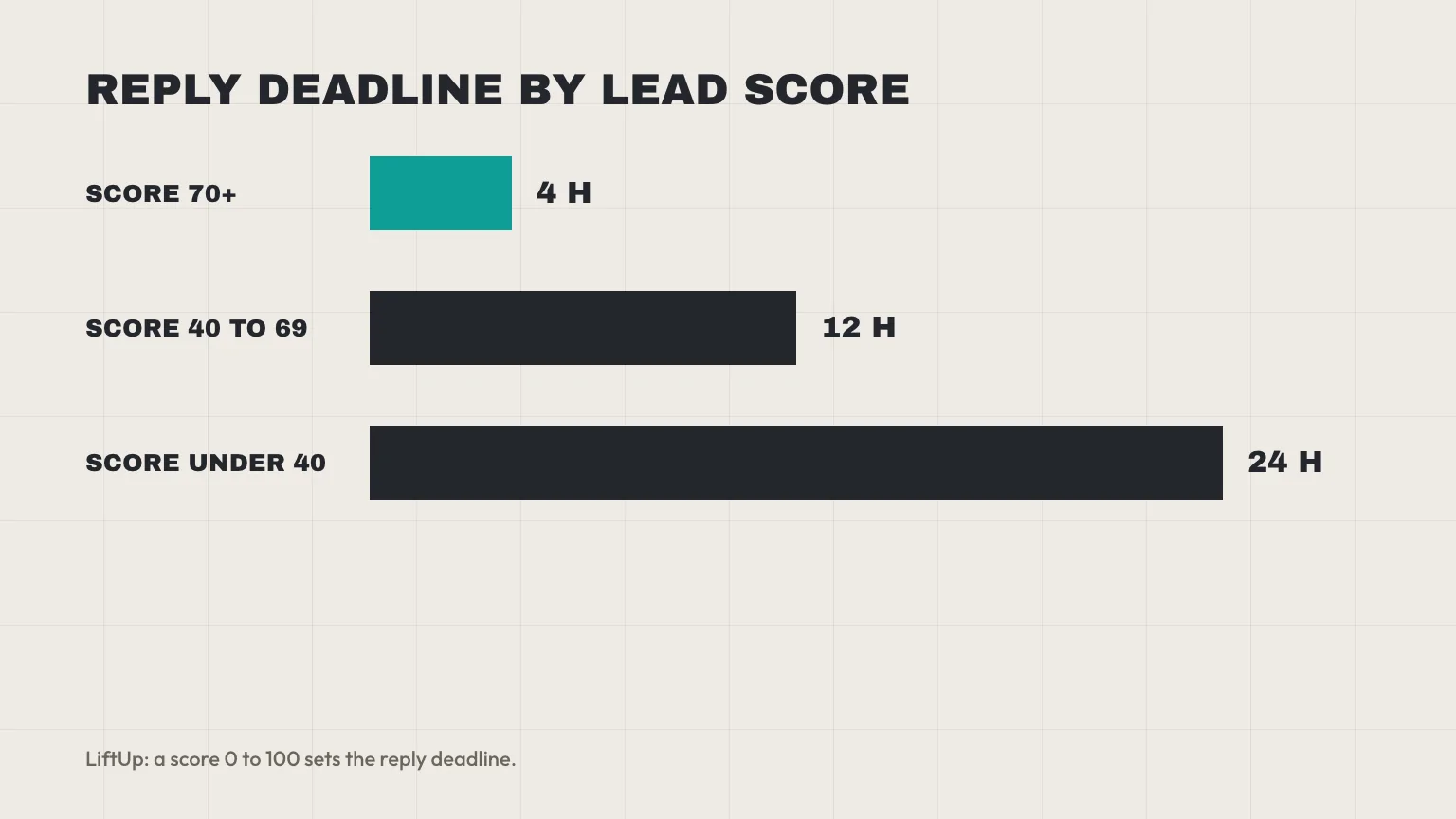
Here is how LiftUp does it, as one example. Each lead gets a 0 to 100 score from rules, and the score sets a reply deadline: 4 hours for 70 and above, 12 hours for 40 to 69, and 24 hours below 40. Your form posts each lead, with its page and source fields, to one API endpoint using a per-product key, and the response returns the score and the deadline. On Starter and above, a needs-attention queue also collects leads whose deadline has passed without a reply.
Two details matter for a content-led team. First, the source label you send changes the score: in LiftUp’s default rules, a source containing “google” earns 25 source points, “linkedin” earns 20, and an unrecognised source earns 5. Second, a lead from a page under /blog earns only 5 page points, against 10 for a page that matches no rule and 20 for a contact page. If most of your leads come from articles, that default undersells them. On Starter and above you can re-weight the rules to fit.
If you are still choosing a system, our 9 checks before you sign for CRM software in Oman lists what to ask each vendor.
A note on privacy and fit
Oman has a Personal Data Protection Law (Royal Decree 6/2022), which is relevant when you collect names and emails. Take advice on the privacy notice for your forms; this is general information, not legal advice.
Who LiftUp isn’t for: teams that need an Arabic or right-to-left interface, or WhatsApp, SMS or calling inside the CRM. LiftUp’s interface is English only and has none of those channels. Billing is in US dollars, or in rupees for India. If your buyers live in WhatsApp, pair a messaging tool with whatever CRM you pick.
Next step
This week, do three things: interview your sales lead for the ten buyer questions, mark the form submit as a key event in GA4, and write down who answers the form and by when. Those take an afternoon, and the rest of your content marketing plan in Oman depends on them. If you would like to see how scoring and reply deadlines look on your own enquiry form, book a 30-minute LiftUp demo.
Frequently asked questions
How do you start content marketing in Oman?
Pick one buyer and list the ten questions your sales team hears most often. Set up Search Console, a GA4 key event for the form submit and a reply routine, then publish an answer to each question. This takes about two weeks of setup before the first post goes live.
How many LinkedIn users are there in Oman?
DataReportal reports 1.30 million registered members for Oman, which is 23.5% of the population (late 2025 data). The figure comes from LinkedIn's ad tools and is not a count of monthly active users. About 70.8% of that ad audience was male.
Should B2B content in Oman be in Arabic or English?
It depends on your buyers. If most enquiries arrive in English, start there and add Arabic versions only of the pages that Arabic-speaking buyers ask for. Use separate URLs and hreflang, and have a professional reviewer check each translation.
What days should I publish in Oman?
Oman's weekend is Friday and Saturday, so publish and expect replies from Sunday to Thursday. There is no solid public data on the best posting time, so choose two fixed weekdays and stay consistent for 90 days.
How do you measure B2B content marketing results?
Record the form submit as a GA4 key event and read clicks, impressions and queries in Search Console. Then store the page on every lead in your CRM and compare it with GA4's landing pages, matching by page path.
How long does content marketing take to work in Oman?
Agency estimates vary and are not measured studies. By day 90 a realistic goal is growing impressions, a few ranking queries and the first enquiries that mention an article. Treat a pipeline as a later result.
Do holidays affect a content calendar in Oman?
Yes. National Day falls on Wednesday and Thursday, 25 and 26 November, in 2026, and Ramadan brings shorter private-sector hours that are announced each year. Publish before the break and name who answers enquiries when it ends.

Abidhusain Chidi
Founder & CEO, QalbIT Infotech
Abidhusain Chidi is the founder and CEO of QalbIT Infotech, a software agency in Ahmedabad building web and SaaS products since 2018. He's also CTO at Seekly, an Australian revenue intelligence platform, and is building LiftUp. He writes about CRM, SaaS operations, and shipping multiple products as a small team.
See it live
Watch LiftUp run your whole growth stack
One console for CRM, content, AI editorial and insights — book a 30-minute walkthrough tailored to your team.
Book a demo