Per Seat vs Flat Rate CRM Pricing: 3 to 20 Users
Abidhusain Chidi10 min read
A 10-person sales team pays $200 a month on HubSpot Sales Hub Starter, $149 on LiftUp Growth and $70 on Bigin Express (billed yearly). The flat plan lands in the middle, not at the bottom. That’s the part most articles on per seat vs flat rate CRM pricing leave out: they argue about fairness instead of running the numbers at real team sizes.
We build LiftUp, a CRM priced flat per organization, so we have every reason to want flat to win. But it doesn’t always. Below are list prices from each vendor’s own page, checked 11 October 2026, worked out at 3, 5, 10 and 20 users. You’ll see when a flat plan saves money, when a per-seat plan beats it (ours included), and what flat plans cap instead of seats.
Per seat vs flat rate CRM pricing: the short answer
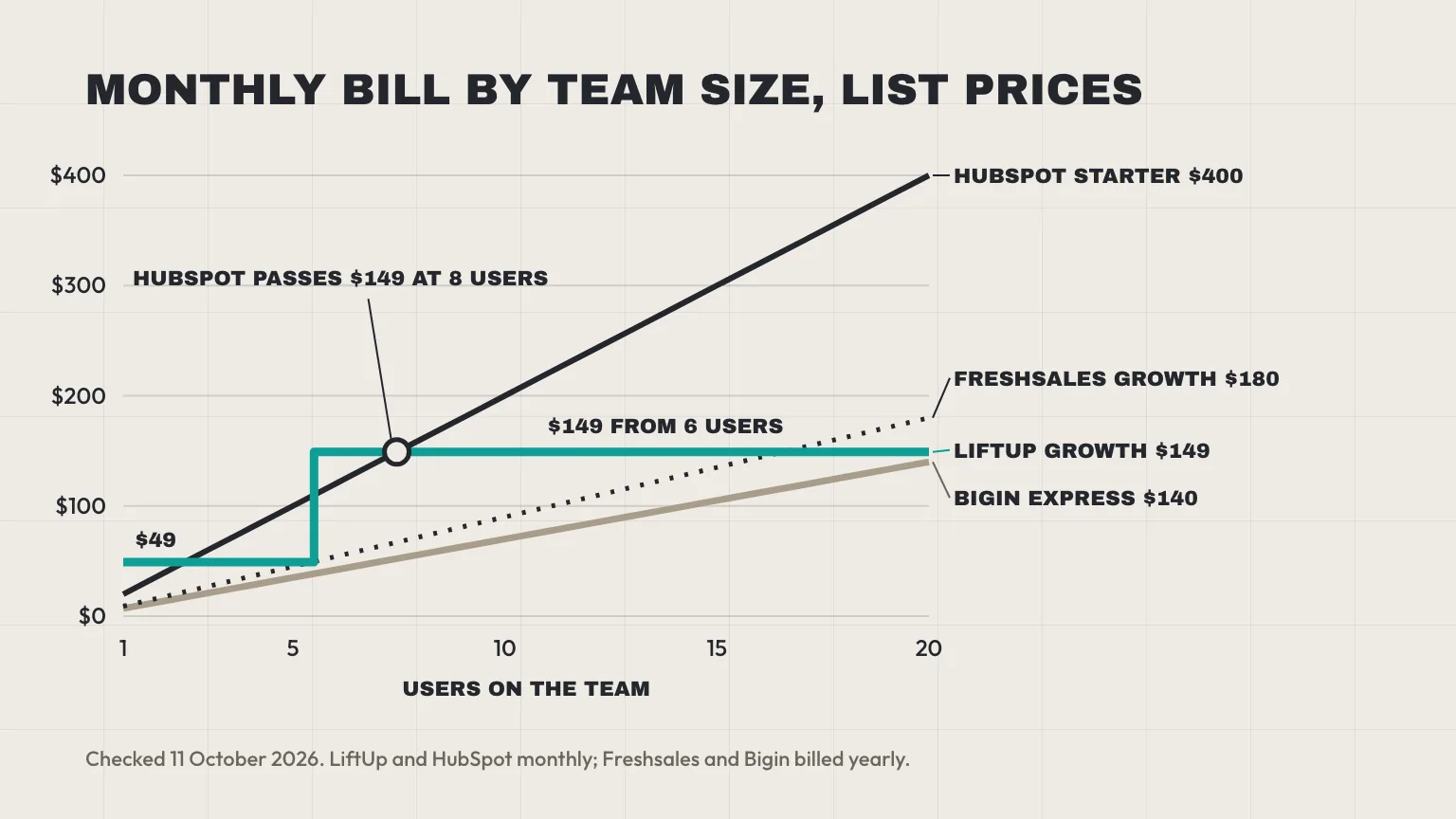
Per-seat pricing is a straight line, since every new user adds the same amount. Flat pricing is a staircase instead: one price up to a user cap, then a jump to the next tier. A flat plan therefore wins just below each cap and loses just above it.
For LiftUp, that means Starter ($49, up to 5 users) beats HubSpot Starter from 3 users, while Growth ($149, up to 20 users) beats it from 8. From 6 to 16 users, though, at least two per-seat entry plans cost less than LiftUp, and Bigin Express stays cheaper all the way to 20. Once you need lead scoring, the picture flips, because most per-seat vendors keep scoring for a higher tier.
How per seat and flat rate CRM pricing work
What a per-seat plan charges for
On a per-seat plan, you pay for each person who can log in and edit records. HubSpot’s product and services catalog lists Sales Hub Starter from $20 a month per seat, Professional from $100 and Enterprise from $150, with no seat minimum for new customers. Then three more things move the bill:
- Tier jumps: features such as lead scoring sit on a higher tier, so the upgrade is charged per seat as well. For example, moving a 10-seat team from Starter to Professional on HubSpot takes the bill from $200 to $1,000 a month.
- Onboarding fees: HubSpot also lists a required one-time onboarding fee of $1,500 for Sales Hub Professional and $3,500 for Enterprise.
- A second meter: each HubSpot tier also includes a monthly allowance of credits (500 on Starter, 3,000 on Professional). Our guide to HubSpot credits shows what a 5-seat team pays when that allowance runs out.
Still, per-seat pricing has one fair point in its favor. HubSpot’s catalog says view-only seats cost nothing, so people who only read reports don’t need a paid seat.
What a flat-rate plan limits instead
A flat plan charges one price per organization and then limits something else. Typical caps cover users per tier, brands or products and leads or records a month, and also storage and AI usage. In other words, “unlimited users” rarely means unlimited everything, and the cap you hit first decides your real tier.
Flat pricing also changes who gets a login. When each one costs $20 a month, the part-time assistant and the founder who checks the pipeline once a week tend to go without. Under a flat price, adding them costs nothing until you reach the cap.
Per seat vs flat rate CRM pricing at 3, 5, 10 and 20 users
Here is per seat vs flat rate CRM pricing as a monthly bill at each team size, in US dollars, from list prices checked 11 October 2026. We’ve also added 6, 7 and 8 users, because the lines cross there.
| Users | LiftUp | HubSpot Sales Hub Starter ($20 a seat) | Freshsales Growth ($9 a user, yearly) | Bigin Express ($7 a user, yearly) | Bitrix24 (yearly) |
|---|---|---|---|---|---|
| 3 | $49 (Starter) | $60 | $27 | $21 | $49 (Basic) |
| 5 | $49 (Starter) | $100 | $45 | $35 | $49 (Basic) |
| 6 | $149 (Growth) | $120 | $54 | $42 | $99 (Standard) |
| 7 | $149 | $140 | $63 | $49 | $99 |
| 8 | $149 | $160 | $72 | $56 | $99 |
| 10 | $149 | $200 | $90 | $70 | $99 |
| 20 | $149 | $400 | $180 | $140 | $99 |
LiftUp and HubSpot are shown at their monthly list prices, while Freshworks, Bigin and Bitrix24 quote headline prices billed yearly. Paid monthly, they cost more (Bigin Express is $9 a user, for example). Mixing the two bases flatters the yearly-billed tools a little, and we’d rather flag that than bury it.
Read the table by column rather than by row. HubSpot Starter climbs $20 for every hire, while LiftUp stays at $149 from 6 users to 20. But the cheapest per-user tools stay below LiftUp across most of the range.
The 6 to 10 user band, where per-seat plans cost less
This is the band where LiftUp is weakest, and we’d rather you hear it from us. At 6 users, LiftUp moves from Starter to Growth and the bill roughly triples, from $49 to $149, while HubSpot Starter costs $120. Bitrix24 Standard, another flat plan, is also cheaper at $99 billed yearly for up to 50 users. Here is where each pair crosses over:
- Starter ($49) against HubSpot Starter ($20 a seat): HubSpot is cheaper at 1 or 2 users, but LiftUp costs less from 3 users until the 5-user cap.
- Growth ($149) against HubSpot Starter: HubSpot is cheaper at 6 and 7 users, then LiftUp wins from 8.
- Starter against Freshsales Growth ($9 a user): Freshsales is cheaper at every size up to 5, so Starter never wins on price alone.
- Growth against Freshsales Growth: Freshsales costs less until 16 users, and LiftUp wins from 17.
- Growth against Bigin Premier ($12 a user): Bigin is cheaper until 12 users, while LiftUp wins from 13.
- Growth against Bigin Express ($7 a user): Bigin stays cheaper at every size up to 20, since 20 users cost $140.
So if you have 6 to 10 users and only need a shared pipeline, a per-seat entry plan or Bitrix24 will usually cost you less than LiftUp. Paying LiftUp yearly narrows the gap, since a year is charged as 10 months and Growth works out to about $124 a month. Even then, it doesn’t close against Freshsales or Bigin.
Compare like with like: plans that include lead scoring
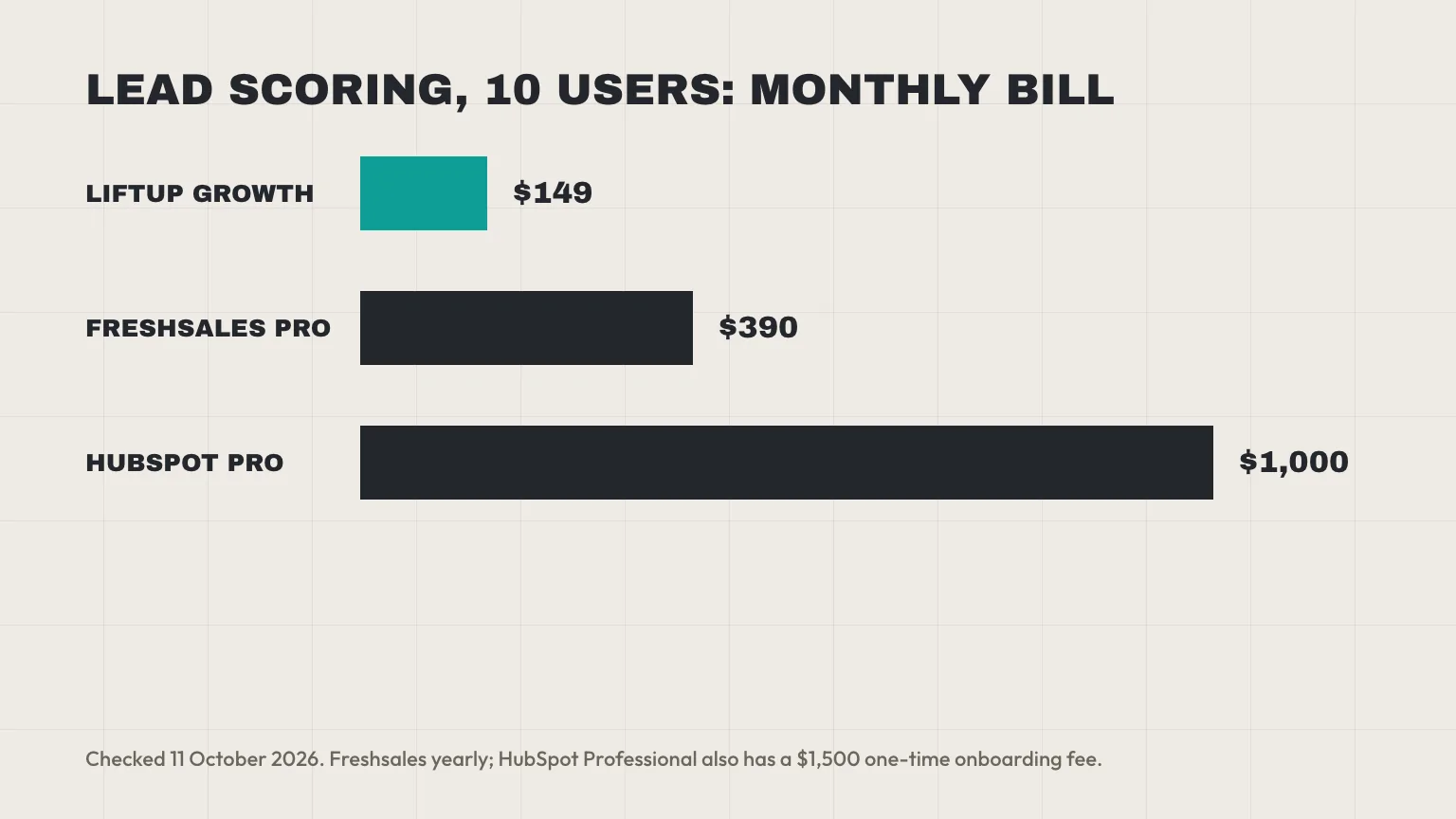
The entry plans above also aren’t equal in features. HubSpot’s catalog lists lead scoring only from Sales Hub Professional, which allows up to 5 scores, while Freshworks shows contact scoring under Freshsales Pro. LiftUp, unlike both, includes a 0 to 100 lead score on Starter and Growth. When scoring is part of the deal, per seat vs flat rate CRM pricing stops being a close call:
| Users | LiftUp | Freshsales Pro ($39 a user, yearly) | HubSpot Sales Hub Professional ($100 a seat, plus $1,500 onboarding) |
|---|---|---|---|
| 3 | $49 | $117 | $300 |
| 5 | $49 | $195 | $500 |
| 10 | $149 | $390 | $1,000 |
| 20 | $149 | $780 | $2,000 |
Part of that gap has a reason, though. LiftUp scores with fixed rules (lead source, landing page, enquiry type, spam check, message content and company), and you can change the weights but not write new rules. HubSpot, on the other hand, lets you build your own scoring rules. What LiftUp adds instead is what the score does next: it sets a reply deadline of 4, 12 or 24 hours by score band, which our post on lead response SLAs explains.
CRM without per user pricing: what flat plans cap
Flat plans are only comparable when you line up their limits, so here are the caps each vendor publishes (checked 11 October 2026).
| Plan | Price a month | Users | Other caps |
|---|---|---|---|
| LiftUp Free | $0 | 2 | 1 product, 100 leads a month, no AI tokens |
| LiftUp Starter | $49 | 5 | 3 products, 1,000 leads a month, 50,000 AI tokens |
| LiftUp Growth | $149 | 20 | 10 products, 10,000 leads a month, 500,000 AI tokens |
| Bitrix24 Basic | $49 yearly, $69 monthly | 5 | 5 pipelines, 24 GB storage |
| Bitrix24 Standard | $99 yearly, $144 monthly | 50 | 10 pipelines, 100 GB storage |
| Kylas (first paid plan) | varies by region (see below) | no cap | 100,000 records, more sold as add-ons |
Bitrix24 caps users by tier, so it’s a staircase with wide steps. Kylas drops the user cap and limits records instead, while LiftUp caps users, products, leads a month and AI tokens together.
LiftUp’s caps, and what happens at each one
Here is what each LiftUp cap does when you reach it:
- Users: once active users reach the plan’s cap, LiftUp refuses new invitations and asks you to upgrade. Only active members hold a seat, so open invitations don’t count.
- Products: each product (a brand, a site or a client) has its own leads, forms, custom fields, blog and API key. Trying to add one past the cap sends you to the upgrade page. Our guide to one CRM for multiple businesses also compares multi-brand setups.
- Leads: the monthly lead cap is a hard stop, so new leads are refused until the next month or an upgrade. API calls get an HTTP 402 response with the error “lead_limit_reached”, while adding a lead by hand shows an upgrade message. Test leads sent with a sandbox key don’t count, though.
- AI tokens: Free has none. On Starter and Growth, AI features stop for the rest of the month once the allowance is used up, with a message asking you to upgrade.
A hard stop is the honest trade-off behind a flat price, so if your lead volume swings, size the plan for your busiest month rather than an average one.
Bitrix24 and Kylas: other flat rate CRM options
Bitrix24 prices by user tier rather than by seat, from 5 users on Basic to 100 on Professional ($199 billed yearly). So for a team of 6 to 50 that wants one predictable bill, Standard at $99 billed yearly is hard to beat on price alone.
Kylas includes unlimited users on every plan and caps records instead: 100,000 on its first paid plan, with more sold as add-ons. Its price, however, depends on where you view it from. The page shows visitors in India ₹12,999 a month and US visitors $175 a month billed yearly, and its top plan is priced by quote.
Flat rate or per seat CRM pricing: a quick test
Five questions settle per seat vs flat rate CRM pricing for your team faster than any vendor calculator. Answer them before you compare quotes:
- Users a year from now: price the plan for that number rather than today’s, because a 5-person team hiring two more lands right in LiftUp’s weakest band.
- Occasional users: if several people only read reports, check whether view-only seats are free, as they are on HubSpot.
- Lead scoring: if you need it, compare against professional-tier per-seat prices instead of entry ones.
- Leads in your busiest month: flat plans often cap leads or records, and a hard cap can matter more than the price.
- Brands or sites: count them against the product or pipeline limit before you pick a tier.
If you’re pricing in rupees, our breakdown of CRM software prices in India runs the same math for 5, 10 and 20 users with Indian list prices.
Who LiftUp isn’t for
LiftUp isn’t the right buy for a team of 6 or 7 that only needs a basic shared pipeline, because HubSpot Starter, Freshsales Growth, Bigin or Bitrix24 will cost less. It also doesn’t suit teams above 20 users, where our Enterprise plan is priced by quote, or teams that sell by phone, SMS or WhatsApp from the CRM, since LiftUp has none of those.
Next step
Before you talk to any vendor, write down three numbers: your user count a year from now, your busiest month’s leads and how many brands you run. Then read across the tables above. Our pricing page also lists every LiftUp cap, and the LiftUp vs HubSpot comparison goes feature by feature. If the math points to a flat plan, book a 30-minute LiftUp demo and we’ll run your team’s numbers with you.
Frequently asked questions
Is flat-rate CRM pricing cheaper than per-seat pricing?
Not always. A flat plan is cheaper once your team passes the break-even point for that plan, and costs more just above each user cap. At 10 users, LiftUp Growth costs $149 a month against $200 on HubSpot Sales Hub Starter, but $90 on Freshsales Growth billed yearly.
How many users before a flat-rate CRM costs less?
Divide the flat price by the per-seat price. LiftUp Growth at $149 against HubSpot Starter at $20 a seat breaks even at 7.45, so LiftUp is cheaper from 8 users. Against Freshsales Growth at $9 a user, the crossover moves to 17 users.
What does a flat-rate CRM limit if not users?
Usually brands or products, leads or records a month, storage and AI usage, and often users per tier as well. LiftUp Starter allows 5 users, 3 products and 1,000 leads a month, while the first paid Kylas plan allows unlimited users and 100,000 records.
Does HubSpot charge per user?
Yes. HubSpot's catalog prices Sales Hub per seat, from $20 a month on Starter, $100 on Professional and $150 on Enterprise, with no seat minimum for new customers. View-only seats are free, and the free tools allow up to two users.
Is there a CRM with unlimited users?
Kylas includes unlimited users on every plan and limits records instead, and its top plan is priced by quote. Bitrix24 is flat too, though each tier still caps users, from 5 on Basic to 50 on Standard and 100 on Professional.
What happens when you hit LiftUp's monthly lead limit?
New leads are refused until the next month starts or you upgrade. API calls get an HTTP 402 response with the error lead_limit_reached, and adding a lead by hand shows an upgrade message. Test leads sent with a sandbox key don't count toward the limit.
Does annual billing change the math?
Yes, so compare on the same basis. LiftUp charges 10 months for a year, which brings Growth to about $124 a month. Freshsales, Bigin and Bitrix24 quote their headline prices billed yearly, and their monthly prices are higher.

Abidhusain Chidi
Founder & CEO, QalbIT Infotech
Abidhusain Chidi is the founder and CEO of QalbIT Infotech, a software agency in Ahmedabad building web and SaaS products since 2018. He's also CTO at Seekly, an Australian revenue intelligence platform, and is building LiftUp. He writes about CRM, SaaS operations, and shipping multiple products as a small team.
See it live
Watch LiftUp run your whole growth stack
One console for CRM, content, AI editorial and insights — book a 30-minute walkthrough tailored to your team.
Book a demo