GCC Currency Peg: Budgeting a USD SaaS Bill
Abidhusain Chidi7 min read
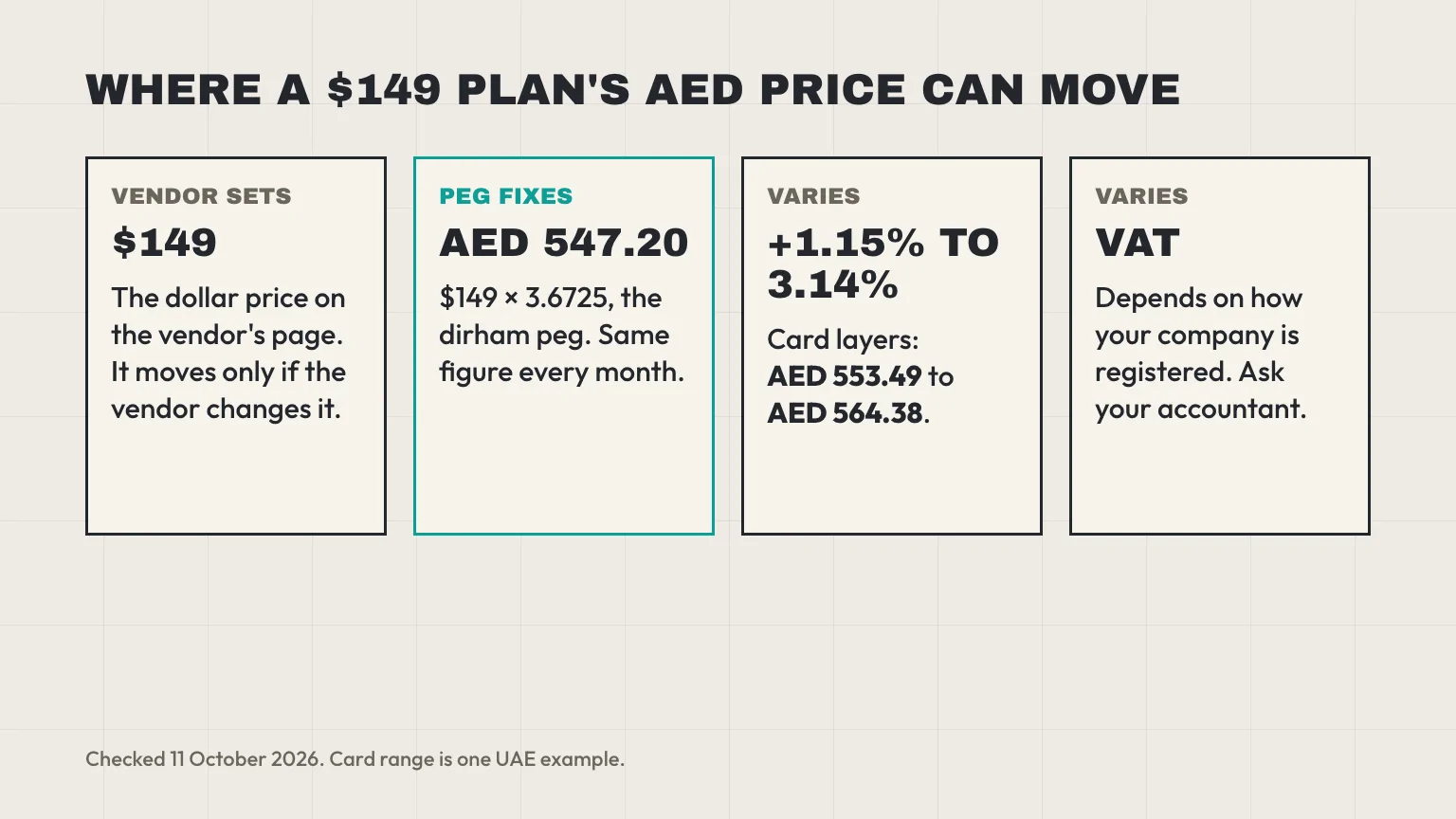
A $149 monthly plan costs AED 547.20 today, and barring a policy change it will cost AED 547.20 next year too. The dirham has been pegged at 3.6725 to the dollar since November 1997, and that GCC currency peg is the reason a USD price is so predictable in the Gulf. You can enter the figure once and leave it alone, at least for the plan price.
The peg only fixes one step, though. Kuwait works differently, your card adds its own layer, and VAT depends on how your company is registered. This guide builds one budget line for a USD-priced SaaS tool, using the pegs as checked on 11 October 2026.
We build LiftUp, which bills GCC customers in US dollars, so we use our own two paid plans as the worked example.
What the GCC currency peg means for a USD price
A peg means the central bank commits to a fixed rate against the dollar. When a vendor lists a plan at $49, the local figure then depends only on that rate, not on oil prices or the week’s news. Five Gulf currencies work this way. Kuwait’s, however, does not.
Five GCC currency peg rates
| Currency | Fixed rate per US dollar | Where it comes from |
|---|---|---|
| UAE dirham (AED) | 3.6725 | IMF 2025 Article IV report, which also says the peg has held since November 1997 |
| Saudi riyal (SAR) | 3.75 | Saudi central bank statement, reported by Arab News in May 2020 |
| Qatari riyal (QAR) | 3.64 | Qatar Central Bank, reported by Gulf Times in 2018 |
| Bahraini dinar (BHD) | 0.376 | Central Bank of Bahrain monetary policy page |
| Omani rial (OMR) | 0.3845 (USD 2.6008 per rial) | Central Bank of Oman, unchanged since 1986 |
Two of those rows rest on news reports of central bank statements, so they are older than the others. The Central Bank of Oman states its peg as USD 2.6008 per rial, so we convert from that figure: 1 divided by 2.6008 is 0.3845 rounded. Bahrain’s rate is on the Central Bank of Bahrain’s page.
Kuwait runs a basket, not a peg
Kuwait’s central bank moved the dinar off the dollar and onto a weighted currency basket in 2007. As far as we could find, it does not publish the weights. So the dinar can drift against the dollar, and a USD price in Kuwait carries a rate risk the other five don’t. We left it out of the tables below because we have no fixed rate to apply. Check the dinar’s rate on the day you budget.
A $49 and $149 plan at the GCC currency peg
These are LiftUp’s Starter and Growth prices, flat per organization and billed monthly in US dollars. Figures are checked 11 October 2026 and show the plan only, before VAT and card charges.
| Currency | Starter, $49 a month | Growth, $149 a month |
|---|---|---|
| AED | 179.95 | 547.20 |
| SAR | 183.75 | 558.75 |
| QAR | 178.36 | 542.36 |
| BHD | 18.424 | 56.024 |
| OMR | 18.840 | 57.290 |
Annual plans scale the same way: $1,490 for Growth is AED 5,472.03 or SAR 5,587.50. Because the rate is fixed, you can put these in a twelve-month budget without a forecast. That only holds for the plan price itself, which is the next problem.
What the GCC currency peg does not fix
Three things sit between the list price and the amount that leaves your account.
Card conversion layers
Your card is in dirhams, riyals or dinars, and the vendor charges in dollars. So the card network converts the amount, and your bank adds its own percentage. The Kredit card guide describes one UAE case: Mastercard bills the issuer 0.9% for a merchant based abroad and 0.2% for the conversion itself, issuers usually pass it on with VAT, and it reaches the statement as roughly 1.15%.
Banks then add a markup of their own. Kredit’s examples run from 0% to 3.14% in total, and a card whose bank waives its own fee can still land near 1.15%, because the network’s charge stays. That is a UAE example, so check your own issuer’s fee schedule.
On the $149 plan at AED 547.20, the range looks like this:
- No card charge: AED 547.20.
- At 1.15%: AED 553.49.
- At 3.14%: AED 564.38.
That is a spread of about AED 17 a month, or about AED 206 over a year. It is small, but it is still a real cost, and the peg does nothing about it.
VAT and the reverse charge
Tax treatment depends on who you are. A guide from Tally Solutions, dated 21 May 2026, says a VAT-registered business buying imported SaaS in the UAE, Saudi Arabia or Oman usually accounts for the VAT itself under the reverse charge, so the foreign vendor does not add local VAT. An unregistered buyer may be charged VAT, depending on the vendor’s own setup. The same guide notes that Qatar and Kuwait had not introduced VAT as of May 2026.
Our USD prices are listed without a VAT line. This is general information, not legal or tax advice, so confirm the treatment with your accountant before you budget it.
Vendor price changes
A fixed rate protects you from currency moves, not from the vendor. If a tool raises its dollar price by 10%, your dirham bill rises by 10%. A vendor that lists a dirham or riyal price sets that figure itself, so it need not equal the dollar price times the peg. Compare the number on the pricing page against your own calculation before you assume they match. Our LiftUp and Zoho comparison covers how those two CRMs differ.
The same logic shows up in other pricing models. Our post on per-seat against flat-rate CRM pricing shows how a USD price per user multiplies across a team, and HubSpot credits show a usage charge that a fixed rate can’t cap.
How safe is the GCC currency peg
Current signals favor the pegs holding. The IMF’s 2025 report on the UAE says “the currency peg to the U.S. dollar remains appropriate”, and its 2025 press release on Saudi Arabia says the Executive Board agreed the same for the riyal. The Central Bank of Oman calls its peg “the preferred exchange rate regime”.
But a peg is a policy, not a law of nature. Qatar replaced an SDR peg with the dollar peg in 2001, and Kuwait moved to its basket in 2007. We won’t predict a change, and neither should a budget. A sensible response is to keep USD as the unit for software lines and convert at review time, so a change in one rate touches a spreadsheet cell, not a contract.
Budget checklist for a USD-priced tool
- Write the vendor’s dollar price first, then multiply by the fixed rate for your currency.
- Treat Kuwait separately and use the day’s rate.
- Add a card layer of up to 3% until your first statement shows the real figure.
- Ask your accountant whether you pay VAT or account for it under the reverse charge.
- Re-check the vendor’s dollar price at each renewal, because that is where most budget drift comes from.
For more on how Gulf buyers compare tools, see our checks before buying CRM software in Oman. If you run several companies, the group-of-companies CRM setup shows how one plan can cover several of them. For the rupee, where nothing is pegged and the rate moves every day, our GoHighLevel India pricing post runs the same exercise.
Who LiftUp isn’t for: teams that must pay in AED, OMR or SAR. LiftUp bills GCC customers in US dollars only. If you need VAT invoices or a local-currency invoice, ask us how we invoice before you buy, or pick a vendor that issues them.
Next step
Open your software budget and write the dollar price next to the local figure for each tool. Then add your card’s real fee from last month’s statement. If you want to see what LiftUp’s flat pricing comes to for your team, book a 30-minute LiftUp demo and we’ll go through the plan, the users and the products you would use.
Frequently asked questions
Which Gulf currencies track the US dollar?
The UAE dirham, Saudi riyal, Qatari riyal, Bahraini dinar and Omani rial each have a fixed rate against the dollar. Kuwait's dinar follows a basket of currencies instead, and the weights are not published.
Is the Omani rial pegged to the dollar, and at what rate?
Yes. The Central Bank of Oman states the fixed peg as USD 2.6008 per rial, unchanged since 1986. That is about 0.3845 rials per dollar, so a $49 plan comes to roughly OMR 18.840.
How many dirhams to the dollar, and has the rate ever changed?
One dollar buys AED 3.6725. The IMF's 2025 report on the UAE says that rate has held since November 1997 and that the peg remains appropriate.
Is the Kuwaiti dinar pegged to the dollar?
Not on its own. The Central Bank of Kuwait moved the dinar from the dollar to a weighted currency basket in 2007, and the weights are not published. For a USD-priced tool, check the dinar's rate on the day you budget.
Do I lose money on exchange when I pay a USD subscription from the UAE?
Not on the rate, since the dirham never moves against the dollar. You can still pay a card conversion layer: one UAE guide puts the network charge near 1.15%, and total card fees in its examples run from 0% to 3.14%.
Do I pay VAT on a foreign software subscription in the GCC?
It depends on whether your business is VAT-registered. A May 2026 guide from Tally Solutions says registered businesses in the UAE, Saudi Arabia and Oman usually account for the VAT themselves under the reverse charge. This is general information, so ask your accountant.
Will the GCC drop the dollar peg?
No one can say. The IMF's 2025 reviews of the UAE and Saudi Arabia both found the peg appropriate, but pegs are policy choices. Qatar changed its anchor in 2001 and Kuwait in 2007, so keep software budgets in dollars and convert at review time.

Abidhusain Chidi
Founder & CEO, QalbIT Infotech
Abidhusain Chidi is the founder and CEO of QalbIT Infotech, a software agency in Ahmedabad building web and SaaS products since 2018. He's also CTO at Seekly, an Australian revenue intelligence platform, and is building LiftUp. He writes about CRM, SaaS operations, and shipping multiple products as a small team.
See it live
Watch LiftUp run your whole growth stack
One console for CRM, content, AI editorial and insights — book a 30-minute walkthrough tailored to your team.
Book a demo